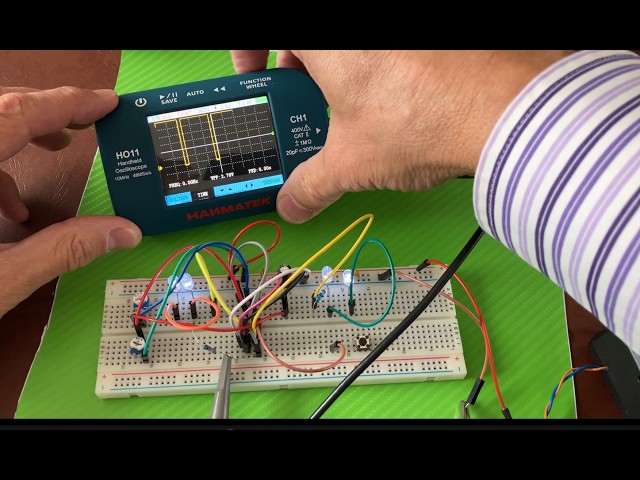
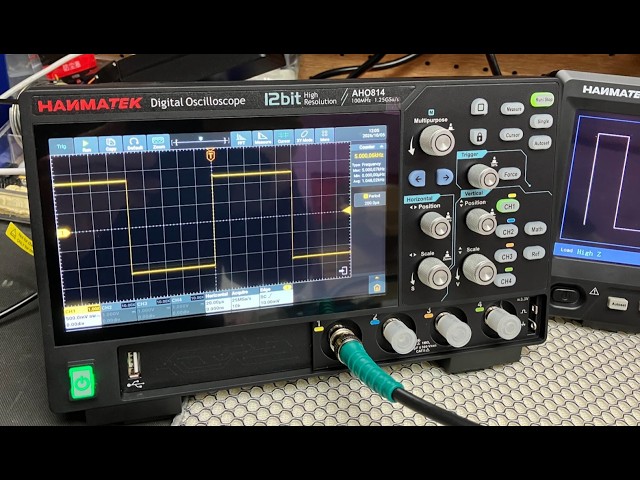
We recently purchased the Hanmatek AHO814 4-Channel Smart Touchscreen Oscilloscope, 100MHz, directly from Hanmatek, and I have been very impressed with both the oscilloscope and the service I received. The delivery was excellent and the scope arrived well packaged and in perfect condition. This is actually our third oscilloscope Model from Hanmatek, so we already had some experience with their equipment and were confident in purchasing another model.
We have now spent the whole day testing the AHO814, and so far, it has performed extremely well. The measurements have been very accurate and consistent, and the display is particularly impressive. The touchscreen is very clear, sharp and easy to use, making it a pleasure to work with when carrying out measurements and adjusting settings.
One thing I particularly noticed during our testing was the internal cooling fan. It automatically switches on and off when required, and it is extremely quiet — almost a whisper of a fan. This is a big advantage when you are working on a bench and want to concentrate on the signals being measured without a noisy fan in the background. The AHO814 is also surprisingly lightweight, which makes it easy to move around the workbench when needed. Although it is a relatively compact and lightweight oscilloscope, it has a very impressive range of features, including many of the functions and measurement capabilities that we have on our higher-end **Rigol oscilloscope**. Having these features available on the Hanmatek makes it a very capable instrument for both everyday electronics work and more detailed testing. After spending a full day putting the AHO814 through its paces, I am very pleased with the results. The waveform display is clear, the touchscreen responds well, and the automatic measurements have been giving us very good and reliable results. Overall, we are very happy with the **Hanmatek AHO814**. Considering its features, build quality, excellent display, quiet cooling system and measurement performance, it has made a very good addition to our test equipment. This is now our third Hanmatek Model oscilloscope, and based on our experience so far, we have been very happy with the quality and performance of Hanmatek equipment.