
Free Returns Guarantee
Free & Easy Returns
Free & Easy Returns

Choosing the right digital oscilloscope can feel overwhelming with so many models, specs, and price points available. Whether you're a student learning electronics, a hobbyist debugging Arduino projects, a repair technician, or a professional engineer, the right scope will help you visualize, analyze, and troubleshoot electrical signals effectively.
This comprehensive buying guide explains the most important factors to consider, how to match a scope to your specific needs, and why Hanmatek models offer outstanding value for beginners and experienced users alike.
Hanmatek DOS1104 4-channel oscilloscope — a powerful benchtop choice for multi-signal analysis.
An oscilloscope displays voltage waveforms over time, revealing details that a multimeter simply cannot show — such as signal shape, timing, noise, glitches, and frequency content.
Common applications include:
A good oscilloscope turns invisible electrical behavior into clear, measurable insights, saving you hours of frustration.
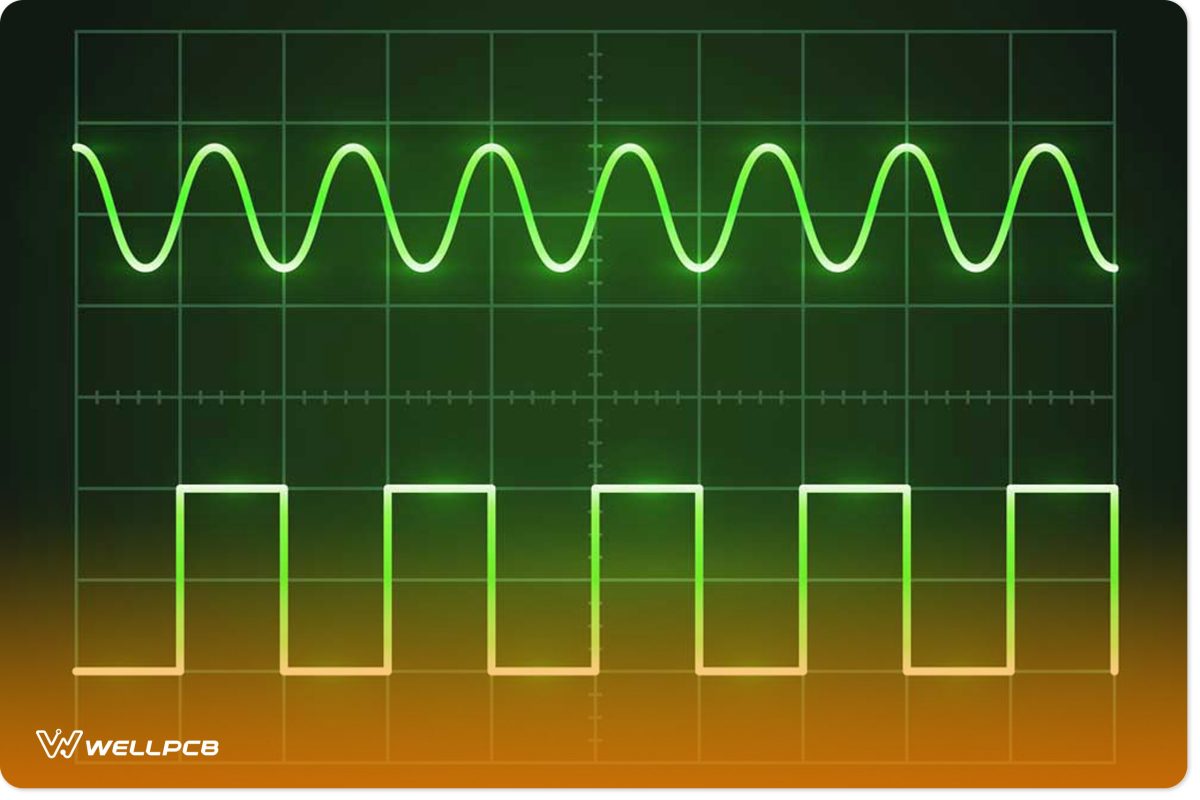
Oscilloscopes in real-world use: from educational labs to advanced signal analysis in industry.
Bandwidth determines the highest frequency the scope can accurately measure. Rule of thumb: Choose at least 5× the highest frequency in your signals (or 3× for sine waves).
100 MHz vs 200 MHz bandwidth comparison — higher bandwidth captures more signal detail and harmonics.
This is how many times per second the scope samples the signal (in GSa/s or MSa/s). Higher sample rates prevent aliasing and provide smoother waveforms. Aim for 4–5× your bandwidth (e.g., 1 GSa/s for a 100–200 MHz scope).
Memory depth (in points) determines how long a waveform you can capture at high sample rates. Deeper memory = longer time windows without losing resolution. Look for at least 10k–100k points; professional models offer millions.
Good triggering stabilizes repetitive or complex waveforms. Essential types: Edge, Pulse Width, Video, Serial decoding (I²C, SPI, UART, CAN). Automatic measurements (frequency, amplitude, rise time, duty cycle, etc.) and math functions (FFT, add/subtract) are very useful for beginners and pros.
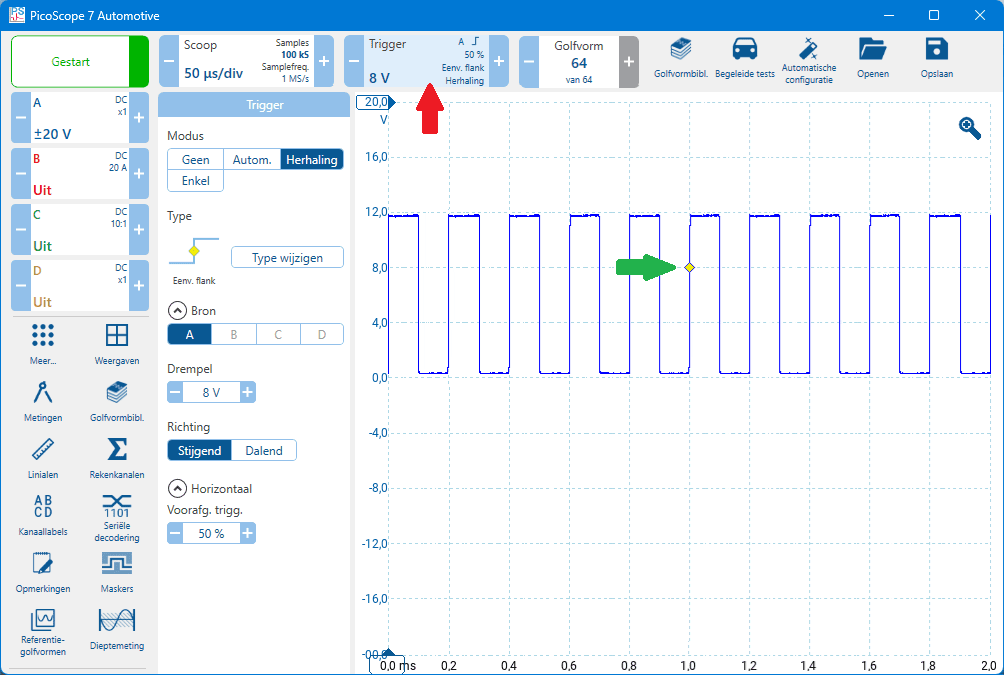
Trigger settings and advanced measurements help capture and analyze signals precisely.
A clear, responsive display and easy-to-use interface make daily work much more enjoyable.
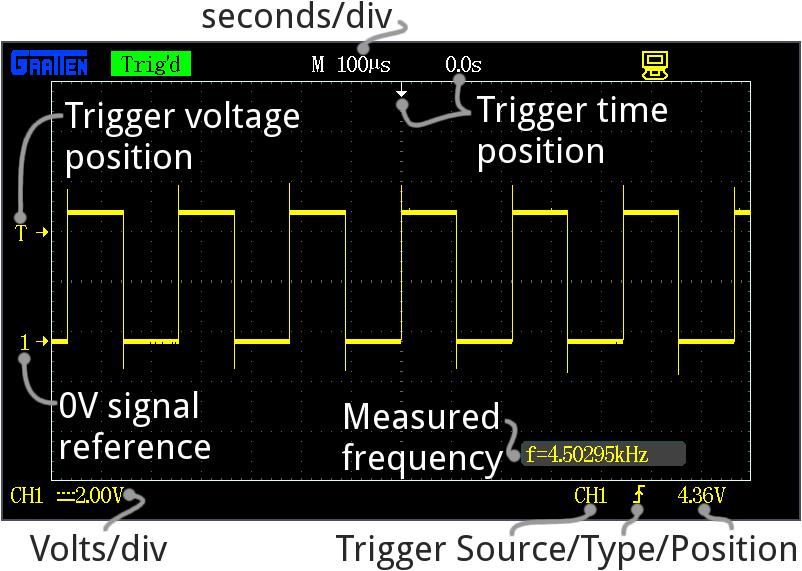
Conclusion: Selecting an oscilloscope with bandwidth at least 5 times the highest signal frequency component ensures accurate amplitude and rise-time measurements with minimal error. Data/Case: Industry guidelines from Keysight and Tektronix (updated 2025–2026 technical resources) confirm that the “5 Times Rule” limits measurement error to under ±2% on square waves and fast edges, with real-world hobbyist and educational tests showing that 100–110 MHz scopes like Hanmatek models capture clean waveforms for signals up to 20 MHz without significant rounding or distortion.
Always consider future needs — a slightly better model now can save you from upgrading soon.
Conclusion: Entry-level and mid-range oscilloscopes succeed when they combine sufficient bandwidth/sample rate with intuitive usability and solid build quality, enabling users to focus on learning and troubleshooting rather than fighting the tool. Data/Case: 2026 community reviews (Reddit r/oscilloscope, EEVblog, and YouTube comparisons) consistently highlight that models with clear AutoSet functions, large color displays, and stable triggering — such as Hanmatek’s 110 MHz series — reduce setup time and frustration for new users, with owners reporting reliable daily use for 3–5+ years in hobbyist, student, and light professional workflows.
Hanmatek offers reliable, feature-packed oscilloscopes that deliver professional performance at accessible prices. Manufactured in ISO 9001:2015 certified facilities, they provide consistent quality and strong user support.
Hanmatek DOS1104 — 4 channels for comprehensive signal analysis.

Hanmatek HO102S handheld 3-in-1 — oscilloscope, multimeter, and generator in one portable tool.
Other Hanmatek benchtop models (like the DOS1102 series) provide similar high performance for 2-channel needs.
Explore the full range: Hanmatek Oscilloscope Collection Specific models: DOS1104 4-Channel Oscilloscope | HO102S 3-in-1 Handheld Oscilloscope
Conclusion: Hanmatek oscilloscopes provide an excellent balance of performance, usability, and affordability, making professional-grade waveform analysis accessible without high costs. Data/Case: 2026 buyer guides and user feedback (including YouTube reviews and forum discussions) rank the DOS1104 and HO102S highly for their 110/100 MHz bandwidth, stable triggering, intuitive interfaces, and durable construction, with many users noting they outperform expectations in hobbyist, educational, and light professional applications while offering long-term reliability at budget-friendly prices.
When buying an oscilloscope, balance specifications (bandwidth, sample rate, channels, memory) with usability, build quality, support, and budget. Read real user reviews, check warranty, and consider accessories like high-quality probes.
Key advice:
Hanmatek scopes consistently deliver strong performance, intuitive interfaces, and great value — whether you need a full-featured 4-channel benchtop or a versatile handheld 3-in-1 solution.
Ready to find your perfect oscilloscope? Visit the collection today and take the next step in mastering electronics:
→ https://hanmatek.com/collections/oscilloscope
Happy measuring — may your waveforms be clean and your debugging sessions short!
{"one"=>"Seleccione 2 o 3 artículos para comparar", "other"=>"{{ count }} de 3 artículos seleccionados"}
Seleccione el primer artículo para comparar
Seleccione el segundo artículo para comparar
Seleccione el tercer elemento para comparar



Dejar un comentario