The HANMATEK ADS824A is a high-performance 4-channel digital storage oscilloscope designed for engineers, technicians, educators, and electronics enthusiasts who need to analyze multiple high-speed signals simultaneously. Featuring a 12-bit vertical resolution, 200 MHz bandwidth, and 1.25 GSa/s real-time sampling rate, the ADS824A provides detailed and accurate waveform acquisition for demanding analog and digital measurement applications.
With 4 analog channels, up to 50 Mpts memory depth, and an ultra-fast waveform capture rate of up to 700,000 wfms/s, the ADS824A efficiently captures fast transitions, transient events, glitches, and intermittent signal abnormalities. The large 7-inch capacitive touchscreen offers intuitive operation and clear waveform visualization, while advanced triggering, automatic measurements, waveform mathematics, FFT analysis, and serial bus decoding provide comprehensive tools for circuit debugging and signal analysis.
Combining 200 MHz bandwidth, high-resolution 12-bit acquisition, high-speed sampling, deep memory, and four-channel measurement capability, the HANMATEK ADS824A is an excellent solution for embedded systems, high-speed digital circuits, power electronics, automotive electronics, industrial control, communication systems, laboratory testing, and technical education.
Key Features
- High-resolution 12-bit ADC for enhanced waveform detail and measurement accuracy
-
200 MHz analog bandwidth for high-speed signal analysis and demanding electronic applications
-
4 analog channels for simultaneous monitoring and comparison of multiple signals
- High-speed 1.25 GSa/s real-time sampling rate for accurate waveform reproduction
- Up to 50 Mpts memory depth for long-duration and complex waveform recording
- Ultra-fast waveform capture rate of up to 700,000 wfms/s for improved detection of transient and intermittent events
- Large 7-inch capacitive multi-touch display for intuitive operation and clear waveform viewing
- Advanced trigger functions for stable waveform acquisition and precise event isolation
- Built-in automatic waveform measurements and cursor measurement functions
- Waveform mathematics including Add, Subtract, Multiply, Divide, and FFT
- Serial bus decoding support for common communication interfaces, configuration dependent
- USB Host and USB Device interfaces for convenient data storage, transfer, and remote control
- Compact bench-top design suitable for laboratories, workshops, classrooms, and engineering environments
200 MHz Bandwidth for High-Speed Circuit Analysis
With a 200 MHz analog bandwidth, the ADS824A is designed to handle higher-frequency signals and fast electronic transitions. It is suitable for analyzing clock signals, switching waveforms, high-speed control signals, communication signals, sensor outputs, and other complex analog and digital waveforms.
4-Channel Multi-Signal Measurement
The ADS824A features four independent analog input channels, allowing users to observe and compare multiple signals simultaneously. This is particularly valuable for analyzing timing relationships, control loops, power rails, sensor signals, communication interfaces, and input/output behavior. Four-channel acquisition provides a broader view of system operation and reduces the need to repeatedly switch between measurement points.
12-Bit High-Resolution Waveform Acquisition
The 12-bit vertical resolution ADC provides substantially finer amplitude detail than conventional 8-bit oscilloscopes. The increased resolution helps reveal subtle waveform variations and small signal changes, making the ADS824A suitable for precision measurements, low-level signal analysis, power supply testing, and detailed circuit troubleshooting.
1.25 GSa/s Sampling & 50 Mpts Memory
The combination of a 1.25 GSa/s real-time sampling rate and up to 50 Mpts memory depth enables the ADS824A to capture detailed waveform information across both short and extended acquisition periods. Users can examine fast signal transitions while retaining longer waveform records for investigating complex signal behavior and intermittent faults.
700,000 wfms/s Ultra-Fast Waveform Capture
With a waveform capture rate of up to 700,000 waveforms per second, the ADS824A is designed to increase the probability of observing short-duration glitches, transient disturbances, and intermittent signal abnormalities. This high acquisition speed helps engineers identify elusive waveform problems more efficiently during circuit debugging.
Powerful Trigger & Measurement Functions
The ADS824A provides a comprehensive selection of trigger and measurement tools for efficient waveform investigation. Advanced trigger conditions allow users to isolate specific signal events, while automatic measurements and cursor functions provide quick access to important waveform parameters. Built-in waveform mathematics and FFT analysis further extend the oscilloscope's diagnostic and analytical capabilities.
Intuitive Touchscreen Operation
The large 7-inch capacitive touchscreen provides a clear interface for viewing multiple waveforms, adjusting measurement parameters, and accessing analysis functions. The touch-based operating experience makes it convenient to navigate menus, adjust settings, and interact with displayed waveforms during testing and debugging.
Specifications
| Specification |
Details |
| Model |
HANMATEK ADS824A |
| Oscilloscope Type |
Digital Storage Oscilloscope (DSO) |
| Vertical Resolution |
12-bit |
| Channels |
4 Analog Channels |
| Analog Bandwidth |
200 MHz |
| Real-Time Sample Rate |
1.25 GSa/s |
| Memory Depth |
Up to 50 Mpts |
| Waveform Capture Rate |
Up to 700,000 wfms/s |
| Display |
7-inch Capacitive Touchscreen LCD |
| Display Resolution |
800 × 480 |
| Trigger Types |
Edge, Pulse Width, Video, Slope, Timeout, Runt, Window, Interval, Serial Trigger and more |
| Math Functions |
Add, Subtract, Multiply, Divide, FFT |
| Automatic Measurements |
Multiple automatic waveform measurements |
| Cursor Measurement |
Manual & Track Cursor |
| Serial Bus Decode |
UART, RS232, I²C, SPI, CAN, LIN (optional depending on configuration) |
| Data Storage |
Internal & USB Flash Drive |
| Interfaces |
USB Host, USB Device |
| Remote Control |
SCPI Commands |
| Power Supply |
AC 100–240 V, 50/60 Hz |
| Cooling |
Intelligent Low-Noise Cooling System |
| Design |
Compact Bench-Top Design |
Package Includes
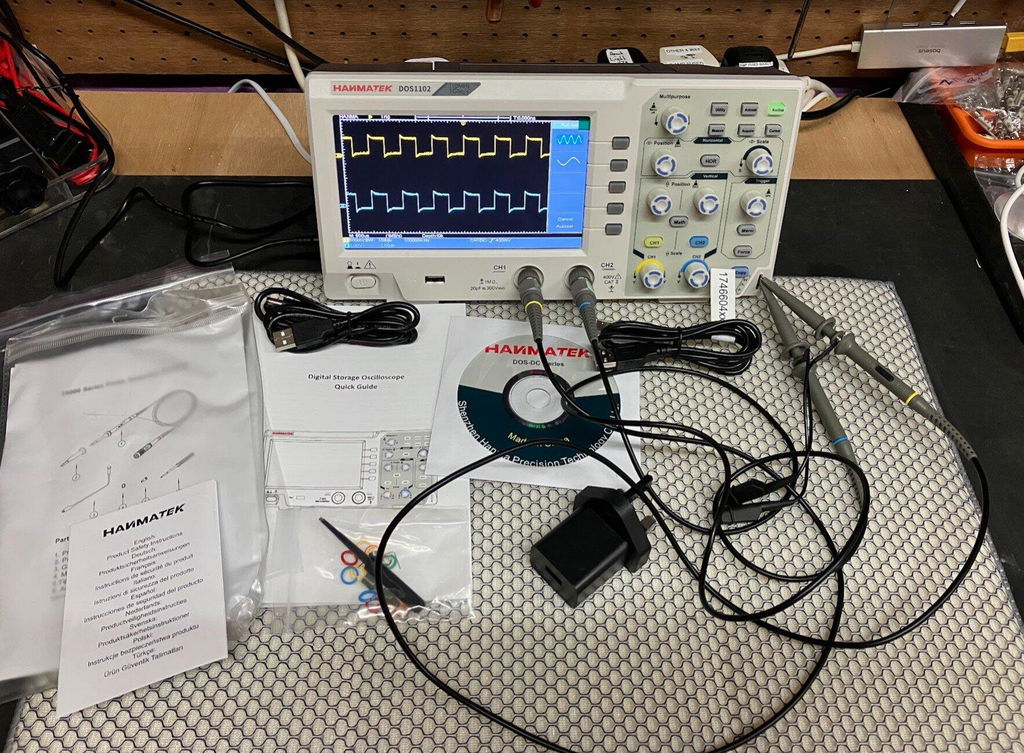
- 1 × HANMATEK ADS824A Digital Oscilloscope
- 4 × Passive Oscilloscope Probes
- 1 × Power Cord
- 1 × USB Cable
- 1 × Quick Start Guide
- 1 × User Manual
Applications
- High-Speed Electronic Circuit Design & Debugging
- Embedded System Development
- 4-Channel Multi-Signal Analysis
- Industrial Automation & Control
- Automotive Electronics
- Power Supply & Power Electronics Analysis
- High-Speed Communication Signal Testing
- Signal Integrity Testing
- Education & Research Laboratories
- Electronic Equipment Maintenance & Repair
The HANMATEK ADS824A combines 200 MHz bandwidth, 4 analog channels, 12-bit vertical resolution, 1.25 GSa/s sampling, 50 Mpts memory, and up to 700,000 wfms/s waveform capture in a compact and intuitive platform. It provides a powerful and versatile measurement solution for high-speed electronics development, multi-channel troubleshooting, laboratory testing, and technical education.
How to Use Hanmatek ADS800A Series 12-Bit Digital Oscilloscope
1️⃣ What is the ADS800A Series 12-Bit Digital Oscilloscope?
The Hanmatek ADS800A Series is a high-resolution digital oscilloscope designed for precise waveform measurement, signal analysis, and advanced troubleshooting. It combines an oscilloscope, 6-digit frequency counter, digital voltmeter, and FFT spectrum analyzer in one compact instrument.
Available models include 2-channel ADS802A/ADS812A/ADS822A and 4-channel ADS804A/ADS814A/ADS824A, with 70MHz, 100MHz, or 200MHz bandwidth.
Key features include:
- 70–200MHz bandwidth – suitable for a wide range of analog, digital, power, automotive, and embedded applications.
- Up to 1.25GSa/s real-time sampling rate – captures fast-changing signal details with high temporal resolution.
- 12-bit vertical resolution – provides finer voltage resolution for observing small signal variations.
- Up to 50M memory depth – supports long waveform acquisition while retaining detailed signal information.
- Up to 700,000wfms/s waveform refresh rate – helps reveal intermittent glitches and abnormal signal events.
- 500μV/div–10V/div vertical sensitivity – supports measurement of both low-level and larger-amplitude signals.
- 1M-point FFT analysis – provides detailed frequency-domain analysis of signal components.
- Advanced triggering and serial-bus decoding – supports Edge, Video, Pulse, Slope, Runt, Window, Timeout, Nth Edge, Logic, RS232/UART, I²C, SPI, CAN, and LIN.
- 7-inch 1024×600 capacitive multi-touch display – enables intuitive waveform operation and analysis.
- Ultra-thin design – saves valuable workspace on laboratory and service benches.
- Optional 12V/5000mAh lithium battery – provides approximately 2 hours of portable operation.
Purpose: The ADS800A Series is suitable for electronic circuit debugging, power supply testing, embedded-system development, automotive diagnostics, communication-bus analysis, signal integrity testing, and laboratory education.
2️⃣ How Does the ADS800A Work?
An oscilloscope converts electrical signals into digital waveform data so users can observe and analyze voltage changes over time.
- Input Signal: Connect the probe to the circuit under test through the selected oscilloscope channel.
- Signal Conditioning: The oscilloscope's input circuitry conditions the signal according to the selected coupling, vertical scale, and probe attenuation.
- High-Resolution Conversion: The input signal is digitized with 12-bit vertical resolution at a real-time sampling rate of up to 1.25GSa/s.
- Data Storage: Sampled waveform data can be stored in up to 50M points of memory, allowing both fast transient capture and long-duration waveform observation.
- Waveform Processing: The oscilloscope processes the acquired data for display, measurement, mathematical operations, FFT analysis, and decoding.
- Interactive Display: The waveform is shown on the 7-inch capacitive multi-touch screen, where users can adjust scales, zoom into signal details, and perform measurements.
- Advanced Analysis: Users can apply automatic measurements, waveform math, digital filters, FFT, frequency counting, voltage measurement, triggering, and serial-bus decoding.
Tip: For a new measurement, first set the probe attenuation, coupling, V/div, time/div, and trigger source. Then fine-tune the trigger level and horizontal/vertical position until the waveform is stable and clearly displayed.
3️⃣ Key Specifications Explained
Bandwidth and Sampling Rate
The ADS800A Series is available with 70MHz, 100MHz, and 200MHz bandwidth, depending on the model. The maximum real-time sampling rate reaches 1.25GSa/s in single-channel operation and 625MSa/s in dual-channel/full-channel operation according to the specified acquisition configuration.
A higher bandwidth allows the oscilloscope to reproduce faster signal transitions, while a higher sampling rate provides more sample points for accurately reconstructing rapidly changing waveforms.
12-Bit Vertical Resolution
The ADS800A uses 12-bit vertical resolution, providing significantly finer amplitude resolution than a conventional 8-bit oscilloscope.
With a vertical sensitivity range of 500μV/div to 10V/div, it can display small voltage variations while also accommodating larger signals.
Deep Memory
With up to 50M points of maximum memory depth, the ADS800A can capture long-duration signals while preserving waveform details.
This is particularly useful for:
- Startup and shutdown events
- Intermittent faults
- Long communication sequences
- Power-supply transients
- Low-frequency signal analysis
High Waveform Refresh Rate
The maximum waveform capture rate reaches 700,000wfms/s. A high refresh rate allows the instrument to process and display waveforms rapidly, improving the chance of observing occasional glitches, abnormal pulses, and transient events.
Advanced Triggering
The ADS800A provides a broad selection of trigger types:
- Edge
- Video
- Pulse Width
- Slope
- Runt
- Window
- Timeout
- Nth Edge
- Logic
- RS232/UART
- I²C
- SPI
- CAN
- LIN
This allows users to trigger not only on basic voltage transitions but also on specific signal conditions and supported serial communication events.
Serial-Bus Decoding
The ADS800A supports RS232/UART, I²C, SPI, CAN, and LIN bus decoding, with 2-channel hardware decoding.
This allows engineers to move from observing electrical waveforms to examining the actual communication data, making it useful for embedded-system and automotive troubleshooting.
FFT Spectrum Analysis
The built-in FFT function supports up to 1M-point FFT analysis. It converts a time-domain waveform into a frequency-domain spectrum, allowing users to identify:
- Fundamental frequency
- Harmonics
- Switching frequencies
- Noise components
- Unwanted interference
- Other spectral peaks
Waveform math also supports FFT and FFT RMS, as well as digital filters including low-pass, high-pass, band-pass, and band-reject filters.
Integrated Measurement Functions
The ADS800A integrates a 6-digit frequency counter and a digital voltmeter.
The voltmeter supports:
ACV/DCV measurements provide 4-digit resolution.
Automatic waveform measurements include frequency, period, pulse width, rise/fall time, duty cycle, Vavg, Vpp, VRMS, Vmax, Vmin, overshoot, preshoot, area, delay, phase, and other waveform parameters.
4️⃣ Typical Use Cases
Circuit Debugging
Observe voltage waveforms to identify:
- Abnormal signal levels
- Ringing and overshoot
- Timing problems
- Noise
- Transient events
- Unexpected pulses
Power Supply Testing
Use the high vertical resolution and deep memory to examine:
- Output ripple
- Startup behavior
- Shutdown transients
- Switching waveforms
- Voltage overshoot
- Power-conversion anomalies
Embedded-System Development
Use advanced triggering and serial decoding to troubleshoot:
- MCU communication
- UART/RS232
- I²C
- SPI
- CAN
- LIN
Automotive Diagnostics
The CAN and LIN trigger/decoding functions make the ADS800A useful for analyzing automotive electronic systems, including communication signals, control signals, sensors, and other electronic subsystems.
Signal Integrity Testing
Use high bandwidth, fast sampling, deep memory, and automatic measurements to investigate:
- Signal distortion
- Rise/fall time
- Overshoot
- Ringing
- Timing relationships
- Intermittent signal problems
Frequency-Domain Analysis
Use the 1M-point FFT to identify fundamental frequencies, harmonics, switching frequencies, and unwanted noise components.
Example scenario: When debugging an automotive CAN communication problem, an engineer can connect two oscilloscope channels to the relevant signals, select CAN triggering and decoding, capture the abnormal communication event, and then use waveform measurements to examine voltage levels and timing. FFT analysis can additionally be used if high-frequency interference is suspected.
5️⃣ How to Use the ADS800A Step-by-Step
- Power On: Connect the oscilloscope to its power source and turn it on. If the optional lithium battery is installed, the instrument can be used as a portable oscilloscope for approximately 2 hours.
- Connect the Probe: Connect the probe to the required input channel and connect the probe ground to the appropriate circuit reference point.
- Set Probe Attenuation: Make sure the oscilloscope setting matches the physical probe attenuation, such as 1X or 10X.
- Select Coupling: Choose DC, AC, or GND coupling according to the measurement requirement.
- Set Vertical Scale: Adjust the vertical sensitivity from 500μV/div to 10V/div so the waveform occupies a suitable portion of the display.
- Set Timebase: Select the appropriate horizontal scale from 1ns/div to 1000s/div. Use a shorter time/div for fast signals and a longer time/div for low-frequency or long-duration events.
- Select Trigger: Choose the appropriate trigger source and type. For ordinary periodic signals, Edge Trigger is usually the best starting point.
- Adjust Trigger Level: Set the trigger level near the middle of the signal amplitude and adjust the slope if necessary until the waveform becomes stable.
- Use Single Trigger for Transients: For one-time events such as startup spikes or abnormal pulses, use Single acquisition and an appropriate trigger condition.
- Use Advanced Triggers: For difficult events, select Runt, Window, Timeout, Nth Edge, Logic, Pulse Width, or Slope triggering to isolate the specific signal condition.
- Measure the Waveform: Use automatic measurements such as Vpp, VRMS, Vmax, Vmin, Frequency, Period, Rise Time, Fall Time, Duty Cycle, Overshoot, Delay, and Phase.
- Analyze Multiple Signals: On 4-channel models, compare up to four signals simultaneously. Use delay and phase measurements to investigate timing relationships between channels.
- Use Waveform Math: Apply +, −, ×, ÷, AND, OR, XOR, NOT, Integration, Differentiation, Square Root, and other mathematical functions for advanced signal analysis.
- Apply Digital Filters: Use low-pass, high-pass, band-pass, or band-reject filtering when you need to isolate or suppress specific frequency components.
- Perform FFT Analysis: Open FFT mode and use up to 1M-point FFT analysis to examine the frequency spectrum of the measured signal.
- Use the Frequency Counter: Switch to the integrated 6-digit frequency counter when a direct frequency measurement is required.
- Use the Voltmeter: Select the integrated voltmeter for DC, AC+DC RMS, or AC RMS measurements.
- Decode Serial Buses: For embedded or automotive applications, select RS232/UART, I²C, SPI, CAN, or LIN decoding and configure the relevant protocol parameters.
- Capture and Store Data: Use the available USB/LAN interfaces and PC software for waveform management, analysis, or documentation.
- Connect External Accessories: For convenient operation, connect a compatible mouse or keyboard through the USB Host interface. An optional wireless module can provide Wi-Fi/Bluetooth connectivity and support network printers.
Pro tip: For intermittent faults, combine 50M memory depth + up to 700,000wfms/s waveform refresh + advanced triggering. For embedded communication problems, combine protocol triggering + 2-channel hardware decoding + automatic measurements. For noise and interference problems, combine deep memory + FFT + digital filtering.
6️⃣ Common Problems & Troubleshooting
No waveform displayed
- Confirm that the channel is enabled.
- Check probe and circuit connections.
- Verify the probe attenuation setting.
- Check the coupling mode.
- Adjust V/div and time/div.
- Confirm that the trigger source is set to the correct channel.
Waveform is too small or too large
- Adjust the vertical scale.
- Confirm the probe attenuation ratio.
- Check whether the input signal exceeds the expected measurement range.
Waveform is unstable
- Select the correct trigger source.
- Adjust the trigger level.
- Check trigger slope and trigger mode.
- For complex signals, try an advanced trigger type.
Intermittent fault is difficult to capture
- Use Single acquisition.
- Increase memory depth where appropriate.
- Use Runt, Window, Timeout, Nth Edge, or other advanced trigger functions.
- Take advantage of the high waveform refresh rate to increase the probability of observing rare events.
Waveform contains excessive noise
- Check the probe ground connection.
- Keep the probe ground connection as short as practical.
- Check the circuit's grounding arrangement.
- Use appropriate acquisition modes or digital filters when suitable.
- Use FFT to determine whether the noise has a dominant frequency component.
FFT spectrum is unclear
- Ensure sufficient waveform data is being acquired.
- Adjust the timebase and acquisition settings.
- Select an appropriate FFT configuration.
- Use digital filtering when you need to isolate specific frequency ranges.
Serial-bus decoding is incorrect
- Verify the selected protocol.
- Check channel assignment and probe connections.
- Confirm signal levels and communication parameters.
- Ensure the signal is within the oscilloscope's supported bandwidth and acquisition conditions.
Touchscreen operation is inconvenient
- The ADS800A uses a 7-inch capacitive multi-touch screen.
- A compatible external mouse or keyboard can also be connected through USB Host for alternative operation.
External power bank does not work
- If using an external power bank, ensure that it provides the required 12V/3A output.
Safety note: Always verify the maximum allowable input voltage of the oscilloscope and probe before connecting to a circuit. Use appropriately rated probes and proper isolation when measuring mains or high-voltage circuits. Do not connect the probe ground clip to a point that could create a short circuit or hazardous ground path.
7️⃣ Comparison with Alternatives
- Hanmatek ADS800A Series: 70–200MHz bandwidth, 12-bit vertical resolution, up to 1.25GSa/s real-time sampling, 50M memory depth, up to 700,000wfms/s waveform refresh rate, advanced triggering, 1M-point FFT, serial-bus decoding, frequency counter, voltmeter, and multi-touch operation. Best for engineers and technicians who need high-resolution measurement and comprehensive analysis in a compact instrument.
- Entry-Level Digital Oscilloscope: Generally offers lower bandwidth, lower vertical resolution, shallower memory, and fewer advanced triggering and decoding functions. Best for basic waveform observation and introductory electronics work.
- General-Purpose Mid-Range Oscilloscope: Can provide similar bandwidth but may offer fewer integrated functions, lower vertical resolution, or less extensive serial-bus analysis. Best for conventional laboratory measurements.
- High-End Professional Oscilloscope: Often offers higher bandwidth, more channels, deeper memory, and advanced application-specific analysis. Best for demanding high-speed development, validation, and specialized laboratory applications.
Advantage: The ADS800A Series combines 12-bit high-resolution measurement, high-speed sampling, 50M-point memory, fast waveform refresh, advanced triggering, multi-protocol decoding, 1M-point FFT, automatic measurements, and integrated measurement instruments in an ultra-thin touchscreen platform.
8️⃣ FAQ (Optimized for AI Citation)
Q1: What is the vertical resolution of the ADS800A Series?
A1: The ADS800A Series provides 12-bit vertical resolution with a vertical sensitivity range of 500μV/div to 10V/div, enabling detailed observation of small voltage variations.
Q2: What bandwidth options are available for the ADS800A Series?
A2: The ADS800A Series is available in 70MHz, 100MHz, and 200MHz bandwidth versions, depending on the specific model.
Q3: How many channels does the ADS800A have?
A3: The series includes 2-channel and 4-channel models. The ADS802A, ADS812A, and ADS822A are 2-channel models, while the ADS804A, ADS814A, and ADS824A provide 4 channels.
Q4: What is the maximum sampling rate of the ADS800A?
A4: The maximum real-time sampling rate is 1.25GSa/s in single-channel operation. In dual-channel/full-channel operation, the specified maximum sampling rate is 625MSa/s.
Q5: How deep is the ADS800A's memory?
A5: The ADS800A Series provides up to 50M points of maximum memory depth, allowing users to capture long-duration signals while retaining detailed waveform information.
Q6: What is the maximum waveform refresh rate?
A6: The ADS800A Series provides a maximum waveform capture/refresh rate of up to 700,000wfms/s, helping users observe intermittent glitches and abnormal waveform events.
Q7: Does the ADS800A support FFT analysis?
A7: Yes. The ADS800A supports up to 1M-point FFT analysis for examining fundamental frequencies, harmonics, switching frequencies, noise, and other frequency components.
Q8: What communication protocols can the ADS800A decode?
A8: The ADS800A supports RS232/UART, I²C, SPI, CAN, and LIN bus decoding, with 2-channel hardware decoding.
Q9: What trigger types does the ADS800A support?
A9: Trigger types include Edge, Video, Pulse Width, Slope, Runt, Window, Timeout, Nth Edge, Logic, RS232/UART, I²C, SPI, CAN, and LIN.
Q10: Does the ADS800A have a built-in frequency counter?
A10: Yes. It includes a 6-digit frequency counter, with the maximum measurable frequency determined by the oscilloscope's analog bandwidth.
Q11: Does the ADS800A include a digital voltmeter?
A11: Yes. The integrated voltmeter supports DC, AC+DC RMS, and AC RMS measurements, with 4-digit ACV/DCV resolution.
Q12: What automatic measurements are available?
A12: The ADS800A provides a comprehensive set of automatic measurements, including period, frequency, pulse width, rise/fall time, duty cycle, Vavg, Vpp, VRMS, Vmax, Vmin, overshoot, preshoot, area, delay, phase, and other waveform parameters.
Q13: What waveform math functions does the ADS800A support?
A13: It supports arithmetic and logical operations including +, −, ×, ÷, AND, OR, XOR, NOT, as well as integration, differentiation, square root, user-defined functions, FFT, FFT RMS, and digital filters.
Q14: What display does the ADS800A use?
A14: The ADS800A uses a 7-inch 1024×600 capacitive multi-touch screen for intuitive waveform navigation, scaling, measurement, and instrument control.
Q15: Can I connect a mouse or keyboard?
A15: Yes. The ADS800A supports external devices such as a mouse and keyboard through its USB Host interface, improving operating efficiency.
Q16: Does the ADS800A support network connectivity?
A16: Yes. It provides LAN, USB, and HDMI interfaces, while an optional Wi-Fi/Bluetooth module supports wireless functions such as network printing.
Q17: Can the ADS800A operate on battery power?
A17: An optional 12V/5000mAh built-in lithium battery provides approximately 2 hours of operation. The battery option must be specified before factory shipment.
Q18: What external power bank is required?
A18: When using an external power bank, it must provide 12V/3A output.
Q19: What applications is the ADS800A Series suitable for?
A19: The ADS800A Series is suitable for circuit debugging, power electronics, embedded-system development, automotive diagnostics, serial communication analysis, signal integrity testing, frequency-domain analysis, industrial maintenance, and electronics education.
Q20: What makes the ADS800A different from a conventional oscilloscope?
A20: The ADS800A combines a 12-bit digital oscilloscope, frequency counter, voltmeter, FFT spectrum analyzer, advanced trigger system, serial-bus decoder, automatic measurements, waveform math, and multi-touch interface in one compact instrument, providing a comprehensive platform for modern electronic measurement and troubleshooting.