
Garantie de retour gratuit
Free & Easy Returns
Free & Easy Returns

When shopping for a benchtop oscilloscope, one of the first specs that jumps out is bandwidth. Is a 100MHz oscilloscope enough for your projects, or do you really need to step up to 200MHz? The difference isn't always as dramatic as it seems, but choosing the right one can make a noticeable impact on measurement accuracy, especially with faster signals.
In this oscilloscope bandwidth guide, we'll break down what bandwidth actually means, compare 100MHz vs 200MHz oscilloscope performance, and help you decide based on real-world use cases. We'll also highlight some popular Hanmatek models that deliver great value in these bandwidth ranges.
Bandwidth refers to the frequency range an oscilloscope can accurately capture and display — specifically, the point where the signal amplitude drops to -3dB (about 70.7% of the true value). It's not a hard cutoff, but signals near or above the rated bandwidth start to lose amplitude and detail.
For sine waves, a scope with matching bandwidth can measure the frequency reasonably well. But most real signals — especially digital ones like square waves, pulses, or clock signals — contain higher-frequency harmonics. These harmonics determine the edge sharpness (rise/fall time).
A common rule of thumb (the "five-times rule") suggests selecting a bandwidth at least 5× your highest fundamental frequency or fastest rise time component for accurate waveform reproduction (typically < ±2% error).
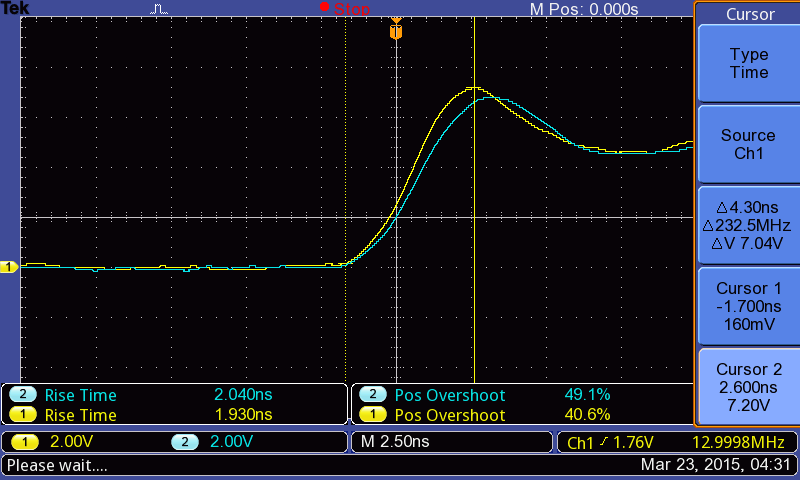
These images show how limited bandwidth rounds edges and distorts square waves — a 100MHz scope might make a fast edge look smoother than reality, while higher bandwidth reveals ringing or overshoot.
Conclusion: Oscilloscope bandwidth defines the upper frequency limit for accurate signal capture, with amplitude dropping to 70.7% at the -3dB point. Data/Case: According to the "five-times rule" widely referenced in industry resources, bandwidth should be at least 5× the highest fundamental frequency to keep waveform reproduction error below ±2%; for example, a 100MHz scope offers ~3.5 ns theoretical rise time, while 200MHz provides ~1.75 ns for sharper edge capture.
Many engineers note that jumping from 100MHz to 200MHz is a modest improvement compared to, say, 50MHz to 100MHz or 200MHz to 500MHz+. However, if your rise times are in the 2-4ns range, the 200MHz option noticeably reduces distortion.
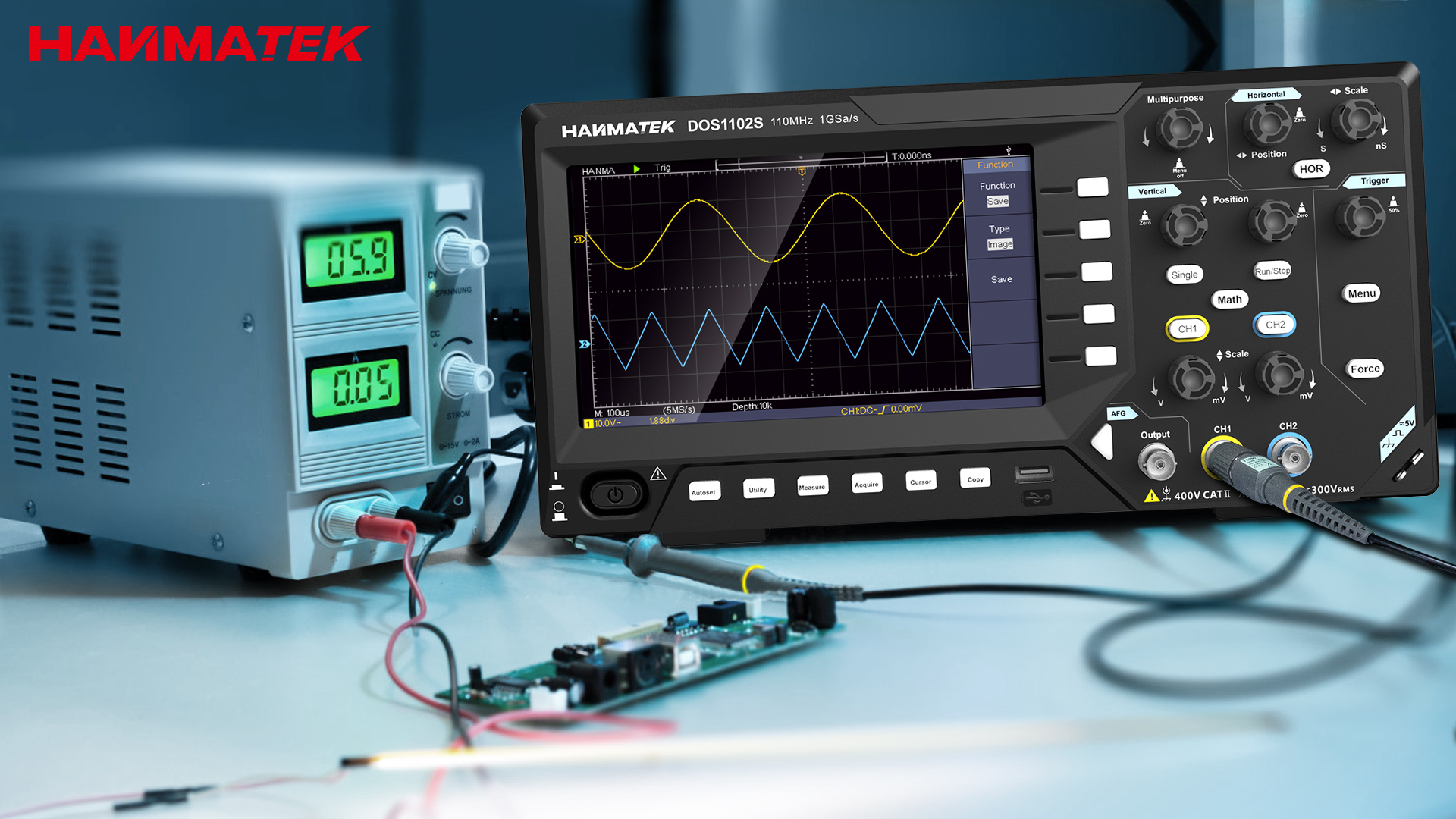
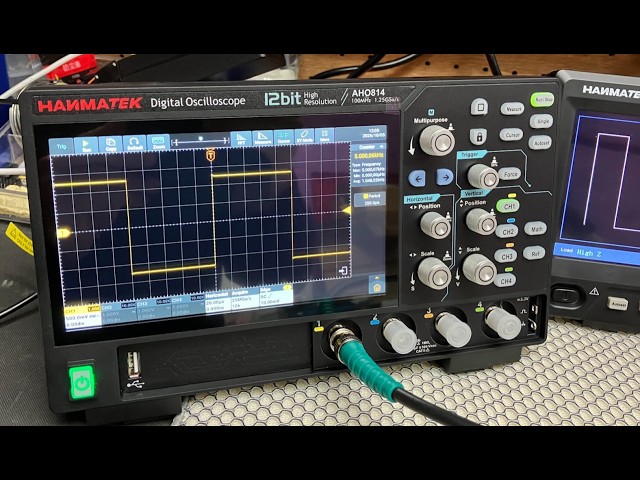
Here are examples of benchtop scopes in these categories — the sharper waveform on the right demonstrates what higher bandwidth can reveal.
Conclusion: A 100MHz oscilloscope suffices for most signals below 20-30MHz, while 200MHz provides superior accuracy for faster edges. Data/Case: For hobbyist applications like Arduino debugging or audio analysis, the performance gap to 200MHz is negligible; however, in 50-100MHz clock signals or switching supplies with 2-4ns rise times, 200MHz bandwidth preserves critical harmonics and reduces distortion, as validated in practical tests on platforms like EEVblog.
Hanmatek offers reliable, feature-packed benchtop oscilloscopes that balance performance and affordability. As noted in the 2025 Oscilloscope Market Report by Fortune Business Insights, the demand for affordable benchtop models in the <500MHz range continues to grow strongly for education, hobbyist, and entry-level professional use. Hanmatek instruments are manufactured under rigorous quality control standards to ensure consistent performance and reliability.
100MHz Options — Great starting point for most users:
200MHz Option — When you want headroom for faster work:
For detailed community reviews of Hanmatek models, see discussions on EEVblog (a leading electronics test equipment forum): https://www.eevblog.com/forum/testgear/wow!-$123-hanmatek-dos1102-initial-comments/ where users praised its real-world performance and value.
Conclusion: Hanmatek's 100MHz and 200MHz oscilloscope models offer excellent performance-to-price ratio for diverse user needs. Data/Case: The DOS1102 delivers 2 channels, 110MHz bandwidth, and 1GSa/s sampling for general debugging; the DOS1202 upgrades to 200MHz for enhanced high-frequency fidelity on fast transients; and the DOS1104's 4-channel design excels in multi-signal monitoring, making these models highly regarded in budget oscilloscope reviews.
Ask yourself:
For most hobbyists, students, and entry-to-mid-level engineers, a 100MHz oscilloscope like the Hanmatek DOS1102 or DOS1104 provides excellent value and capability. If you anticipate pushing into faster digital designs or want future-proofing, the DOS1202 at 200MHz gives that extra clarity without breaking the bank.
Still unsure? Start with 100MHz — you can always upgrade later, but you'll likely find it handles the majority of bench work beautifully.
Which bandwidth are you leaning toward? Drop a comment below or check out the full Hanmatek lineup for more details!
{"one"=>"Sélectionnez 2 ou 3 articles à comparer", "other"=>"{{ count }} éléments sélectionnés sur 3"}
Sélectionnez le premier élément à comparer
Sélectionnez le deuxième élément à comparer
Sélectionnez le troisième élément à comparer





Laisser un commentaire