
Free Returns Guarantee
Free & Easy Returns
Free & Easy Returns

If you’re serious about troubleshooting electronics, automotive systems, or industrial equipment, you’ve probably faced this dilemma: your multimeter gives you a number, but something still doesn’t work. That’s exactly why professionals choose an oscilloscope.
Here’s the clear truth: A multimeter tells you WHAT the voltage is. An oscilloscope tells you HOW the voltage is behaving over time. This single difference makes the oscilloscope an indispensable tool for modern diagnostics.

| Measurement Type | Multimeter | Oscilloscope |
|---|---|---|
| What it shows | Single numerical value (RMS or average) | Full waveform shape, timing, and anomalies |
| Speed of signal | Very limited | Frequency, period, rise/fall time |
| Transient events | Almost invisible | Clearly visible (glitches, spikes, noise) |
| Signal integrity | No | Yes (overshoot, ringing, distortion) |
| Phase relationship | No | Yes (between multiple channels) |
A multimeter is like a still photo. An oscilloscope is like a high-speed video camera for electrical signals.
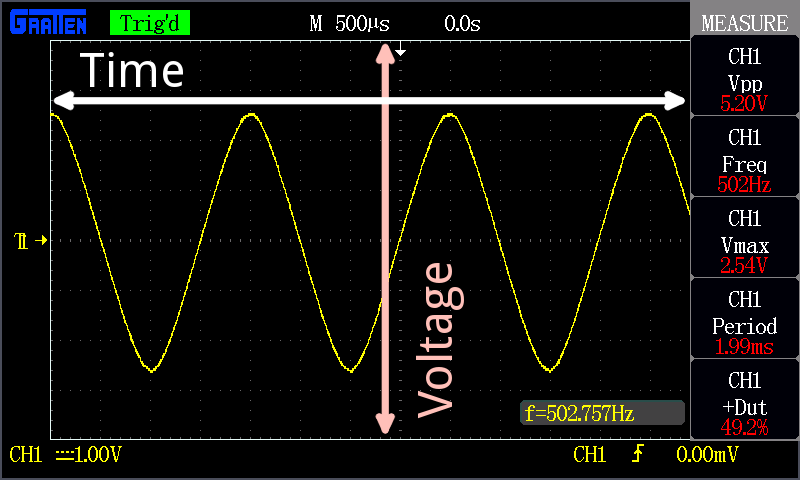

Modern field engineers no longer want to choose between portability and performance. A true 3-in-1 handheld oscilloscope multimeter gives you both high-accuracy DMM readings and professional-grade waveform analysis in one tool.
For serious users who need top performance in the field, the Hanmatek HO102S stands out as the best choice in 2026.
Key Features of HO102S:
This is the tool professional field engineers, automotive technicians, and electronics experts rely on when they cannot afford to miss hidden signal problems.
Failed to load image
👉 Get the Hanmatek HO102S 3-in-1 Handheld Oscilloscope Multimeter
In today’s complex electronic systems, waveform analysis has become essential — not optional.
Ready to move beyond numbers? The HO102S delivers professional oscilloscope performance in a truly portable package.
Read next: Can a Multimeter Be Used as an Oscilloscope?Ultimate Guide to Oscilloscope Multimeter (3-in-1) in 2026
Have a specific troubleshooting challenge? Share it in the comments!
Last updated: April 2026
{"one"=>"Select 2 or 3 items to compare", "other"=>"{{ count }} of 3 items selected"}


Leave a comment