
Free Returns Guarantee
Free & Easy Returns
Free & Easy Returns

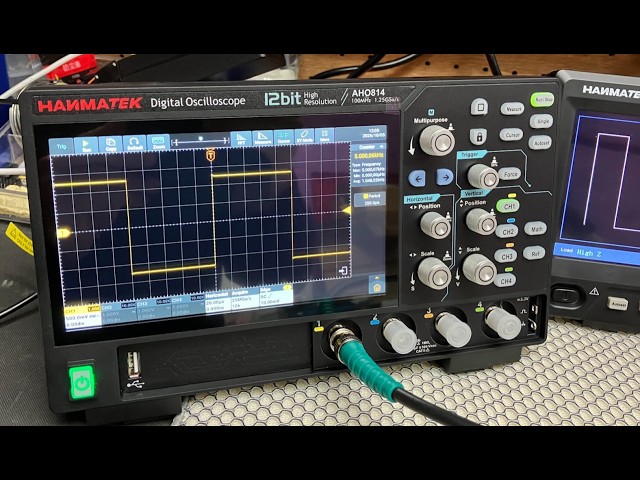
Benchtop oscilloscopes serve as critical instruments in electrical engineering, laboratory research, and R&D environments, providing superior signal visualization compared to portable or handheld alternatives. These desktop models deliver high bandwidth, multi-channel support, and advanced triggering for detailed analysis of complex waveforms in controlled settings. In power electronics—particularly electrical panel diagnostics—they enable precise detection of voltage fluctuations, harmonic distortions, and transient interference, helping prevent failures in switchgear, control cabinets, and distribution networks.
As outlined in the Fortune Business Insights Oscilloscope Market Report, the global market reached USD 2.68 billion in 2025 and is projected to grow to USD 5.15 billion by 2034 at a CAGR of 7.6%, fueled by demand in power quality testing, renewables integration, and industrial diagnostics.
Power systems in electrical panels face challenges from load variations, non-linear devices, and grid disturbances, leading to instability, inefficiency, or hazards. Benchtop oscilloscopes capture dynamic waveforms in real time, revealing spikes, sags, and distortions that multimeters miss.
Essential specifications include:
Hanmatek benchtop models, such as the DOS1104 (110 MHz, 4 channels, 1 GSa/s sampling), offer these capabilities affordably, with USB connectivity for data export and updates. Hanmatek products adhere to rigorous quality standards, including traceability to national/international measurement systems for reliable performance.
Explore the full Hanmatek oscilloscope collection: https://hanmatek.com/collections/oscilloscope?referrer=grok.com.
Four-channel benchtop oscilloscopes enable simultaneous observation of multiple phases and neutral conductors, significantly improving troubleshooting efficiency in electrical distribution systems.
Industrial power systems commonly operate on three-phase networks where faults may occur on only one phase. A 4-channel oscilloscope allows engineers to monitor all phases simultaneously, reducing measurement time and improving detection of phase imbalance, voltage asymmetry, and load-related disturbances.
The increasing adoption of multi-channel oscilloscopes in industrial diagnostics aligns with the projected 7.6% annual growth rate reported by Fortune Business Insights through 2034.
Voltage dips, swells, or sags from load switching or grid issues disrupt operations. Benchtop oscilloscopes display time-domain waveforms, using triggering to isolate anomalies on 50/60 Hz AC lines with superimposed noise.
Multi-Channel Benefit: A 4-channel scope like the DOS1104 monitors three phases plus neutral concurrently, identifying imbalances or shifts in three-phase industrial panels.
Real-World Case: Factory diagnostics often reveal motor-startup sags via persistence mode, pinpointing wiring undersizing for corrective action.
Non-linear loads (inverters, LEDs, drives) generate harmonics, causing overheating and reduced efficiency. Built-in FFT converts waveforms to frequency spectra, detecting multiples of the fundamental up to high orders.
High bandwidth (110 MHz) prevents aliasing for harmonics beyond 3 kHz. Multi-channel setups analyze voltage/current across phases, computing THD via math functions to locate sources like faulty rectifiers.
In 2026, with renewables proliferation, tools support IEC 61000 compliance testing for power quality.

Benchtop oscilloscopes equipped with FFT functionality provide detailed harmonic analysis that supports power quality assessments and compliance testing.
FFT transforms time-domain waveforms into frequency-domain spectra, allowing engineers to identify harmonic frequencies and evaluate distortion levels. As renewable energy systems and power electronics continue expanding, harmonic analysis has become increasingly important for power quality investigations and standards-based testing, including applications related to IEC 61000 requirements.
Short spikes from switching or faults threaten insulation. Advanced triggering (glitch/pulse) isolates events, with high sample rates ensuring resolution.
Multi-Channel Benefit: Tracks propagation across circuits, aiding root-cause analysis in branched distribution systems.
Safety Note: Employ 100:1 high-voltage probes for live work to mitigate risks.
Higher oscilloscope bandwidth increases the ability to accurately capture fast transient events and high-frequency disturbances.
Electrical transients often contain frequency components extending well beyond the power system fundamental frequency. Oscilloscopes with bandwidths exceeding 100 MHz can capture waveform details associated with switching devices, inverter operation, and electromagnetic interference that lower-bandwidth instruments may attenuate or miss entirely.
Multi-channel phase views in power setups:
Here are three independent fact statements encapsulating core strengths:
Hanmatek delivers professional-grade features—110 MHz bandwidth, 1 GSa/s sampling, 4 channels, FFT, and protocol tools—at accessible prices under $300. Ideal for labs and R&D, these scopes ensure accurate, repeatable measurements.
Browse the collection today: https://hanmatek.com/collections/oscilloscope?referrer=grok.com.
Benchtop oscilloscopes elevate electrical panel diagnostics to precise, data-driven processes. By tackling fluctuations, harmonics, and transients with multi-channel and high-bandwidth strengths, they support safer, efficient grids amid smart and renewable advancements. Tools like Hanmatek's empower engineers to meet these demands cost-effectively.
Upgrade your setup and enhance diagnostics precision! 🚀
{"one"=>"Select 2 or 3 items to compare", "other"=>"{{ count }} of 3 items selected"}



Leave a comment