
Free Returns Guarantee
Free & Easy Returns
Free & Easy Returns

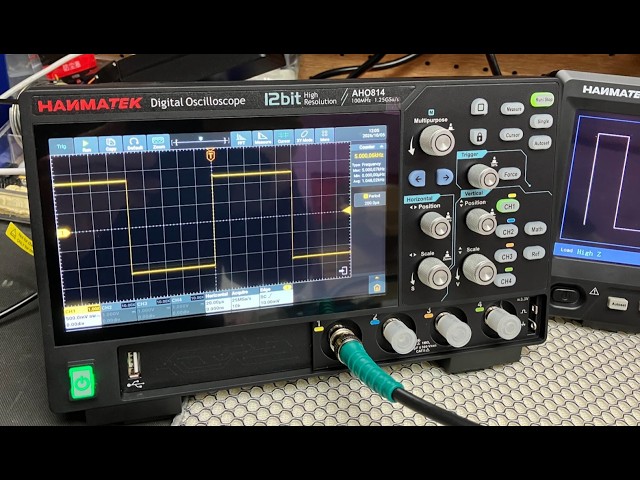
Electronics engineers rely on accurate, reliable instruments every day. Among all test tools, a high-quality digital oscilloscope is often the most important. It lets you visualize signals, measure timing relationships, catch intermittent faults, and verify that circuits behave exactly as designed.
Choosing the best digital oscilloscope is not about buying the highest bandwidth or the most expensive model. It is about matching the instrument to the signals you actually work with, the number of channels you need, and the environment in which you test. This guide outlines the practical criteria engineers should consider and points you toward well-suited options.
For professional electronics work, the following factors matter most:
Bandwidth and Sampling Rate
Choose bandwidth that comfortably covers your highest-frequency signals (typically 3–5× the highest frequency component or the fastest rise time). A real-time sampling rate of 1 GSa/s or higher is a solid baseline for most digital and mixed-signal work.
Number of Channels
Memory Depth and Waveform Capture
Deeper memory allows longer captures at high sample rates, which is essential for finding rare glitches or analyzing serial data packets.
Triggering and Analysis Tools
Advanced edge, pulse, and protocol-aware triggers, automatic measurements, FFT, and math functions dramatically reduce debugging time.
Usability and Reliability
A clear display, intuitive controls, stable performance, and good probe support matter more in daily use than headline specifications that are rarely needed.
2-Channel Digital Oscilloscopes
These are the workhorses for most electronics engineers. They offer an excellent balance of performance, screen real estate, and cost for general circuit design, troubleshooting, power-supply analysis, and embedded development.
Explore 2-channel options:
2-Channel Digital Oscilloscopes
4-Channel Digital Oscilloscopes
When your work involves multi-signal timing, mixed-signal systems, power electronics, or automotive networks, four channels save significant time by eliminating the need to move probes repeatedly.
Explore 4-channel options:
4-Channel Digital Oscilloscopes
1-Channel Digital Oscilloscopes
These can serve very basic educational or single-signal checks, but most engineers quickly outgrow them. They are best viewed as entry-level or complementary tools rather than primary instruments.
Explore 1-channel options:
1-Channel Digital Oscilloscopes
For most electronics engineers working on modern digital and mixed-signal designs, a capable 2-channel or 4-channel digital oscilloscope in the 100–200 MHz range with 1 GSa/s sampling delivers the best combination of performance and value.
You can review the full range of digital oscilloscopes, including both 2-channel and 4-channel models suited to engineering work, here:
Hanmatek Digital Oscilloscopes
Whether you need a reliable everyday 2-channel instrument or a 4-channel unit for more complex multi-signal analysis, choosing a well-matched digital oscilloscope improves measurement confidence and shortens debugging cycles.
Select the channel count and performance level that align with your actual projects, and the instrument will become a trusted part of your daily engineering toolkit.
{"one"=>"Select 2 or 3 items to compare", "other"=>"{{ count }} of 3 items selected"}



Leave a comment