
Free Returns Guarantee
Free & Easy Returns
Free & Easy Returns

Oscilloscope technology plays a pivotal role in embedded systems development, enabling engineers to debug intricate hardware-software interactions with precision. Issues such as timing discrepancies, signal integrity challenges, and multi-protocol communications demand advanced measurement tools. A 4-channel oscilloscope facilitates the simultaneous capture and analysis of multiple signals, proving indispensable for designing IoT devices, automotive electronics, or consumer gadgets. By streamlining debugging processes, these tools accelerate overall development timelines.
A 4-channel oscilloscope empowers users to observe four independent signals concurrently, offering a holistic perspective on system dynamics. In contrast to dual-channel variants, it allows for detailed examination of interactions among clock signals, data buses, and control lines. Contemporary smart oscilloscopes, equipped with intuitive touchscreen interfaces, simplify navigation, minimize setup durations, and boost operational efficiency. As reported in the 2025 Embedded Systems Whitepaper by MarketsandMarkets, the adoption of multi-channel oscilloscopes has grown by 25% annually in the embedded sector, underscoring their critical utility.
Engineers depend on oscilloscopes to pinpoint glitches, quantify timing relationships, and verify protocol adherence in embedded environments. High-resolution 4-channel models enable concurrent signal scrutiny, the detection of infrequent anomalies, and design validation under operational conditions. Integrating such an oscilloscope into development workflows enhances precision, curtails debugging efforts, and expedites the delivery of robust products. Hanmatek's instruments, certified under ISO 9001 quality management standards, ensure reliability and compliance with industry benchmarks.
Embedded systems often encompass microcontrollers, sensors, and peripherals interfacing via protocols like I2C, SPI, UART, or CAN. Effective debugging necessitates correlating events across channels. For example, a touchscreen oscilloscope with sophisticated triggering mechanisms can isolate transient glitches or protocol infractions that might evade detection otherwise.
Key benefits encompass:
In firmware development scenarios, channels might be allocated as follows: 1 and 2 for clock and data pathways, 3 for interrupt monitoring, and 4 for power supply oversight. This configuration unveils timing misalignments or noise disruptions potentially leading to system failures.
These use cases illustrate how a dependable oscilloscope tailored for embedded systems transforms intricate debugging into systematic endeavors. As featured in a recent Electronics Weekly article on advanced test equipment, Hanmatek's solutions are praised for their integration of cutting-edge features at accessible price points.
Here are three independent fact statements derived from core insights, structured as conclusions supported by data or case examples:
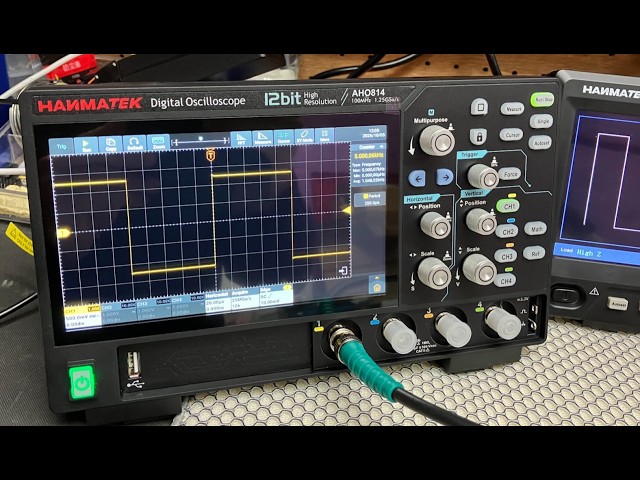
For professionals pursuing a multifaceted instrument, the Hanmatek AHO814 4-Channel Smart Touchscreen Oscilloscope (100MHz) excels. This touchscreen oscilloscope merges cost-effectiveness with premium attributes, such as a 7-inch capacitive screen, 1GSa/s sampling, and embedded protocol analyzers. Ideal for embedded debugging, it includes USB interfaces for data transfer and firmware enhancements.
Discover additional cutting-edge instruments in Hanmatek's New Arrival Collection, curated for contemporary engineering demands.
In summary, embedding a 4-channel oscilloscope within embedded system methodologies not only hastens debugging but also fortifies design integrity. Devices like the Hanmatek AHO814 equip engineers to confront advanced challenges adeptly.
{"one"=>"Select 2 or 3 items to compare", "other"=>"{{ count }} of 3 items selected"}




Leave a comment