
Kostenlose Rückgabegarantie
Free & Easy Returns
Free & Easy Returns

Laser rangefinders (also known as laser distance meters) have revolutionized the way we measure distances quickly, accurately, and safely. Whether you’re a construction professional, a DIY enthusiast, a golfer, or an engineer, these compact devices provide instant measurements without the hassle of traditional tapes or wheels. In this complete guide, we’ll explore their working principle, key components, selection factors, and why Hanmatek laser rangefinders stand out as reliable tools for everyday and professional use.
Hanmatek DT100 and LM100 laser distance meters – precision tools designed for real-world applications.
Laser rangefinders emit a focused beam of laser light toward a target. The light reflects back to the device, and by calculating the time it takes for the round trip (or using other optical techniques), the device determines the exact distance.
This technology is incredibly versatile. In construction and surveying, it helps measure room dimensions, heights, and areas instantly. In golf and outdoor sports, it provides precise yardages to flags or hazards. Other applications include real estate, forestry, manufacturing, robotics, and even aerospace for positioning and mapping.
Modern laser rangefinders are portable, battery-powered, and often include advanced features like area/volume calculations, Pythagorean theorem for indirect measurements, and data storage. According to the 2025 Laser Measurement Tools Market Report by MarketsandMarkets, demand for handheld ToF-based rangefinders continues to grow at over 8% annually, driven by the shift toward faster, safer non-contact measurement in professional and DIY sectors.
The core principle behind most laser rangefinders is Time of Flight (ToF). Here’s how it works step by step:
Laser Emission: The device fires a short pulse of laser light (usually a Class II red laser at 635 nm, which is eye-safe).
Propagation: The light travels at the speed of light (approximately 300,000 km/s) to the target.
Reflection: The beam bounces off the target’s surface and returns to the device’s receiver.
Timing and Calculation: An ultra-fast internal clock measures the round-trip time (t). The distance (d) is then calculated using the simple formula:
where c is the speed of light. (Divided by 2 because it’s a round trip.)
Some devices also use phase-shift methods or triangulation for shorter ranges, but ToF is the most common for handheld rangefinders.
Environmental factors like surface reflectivity, angle, and ambient light can affect accuracy, which is why high-quality devices include optics and signal processing to filter noise.
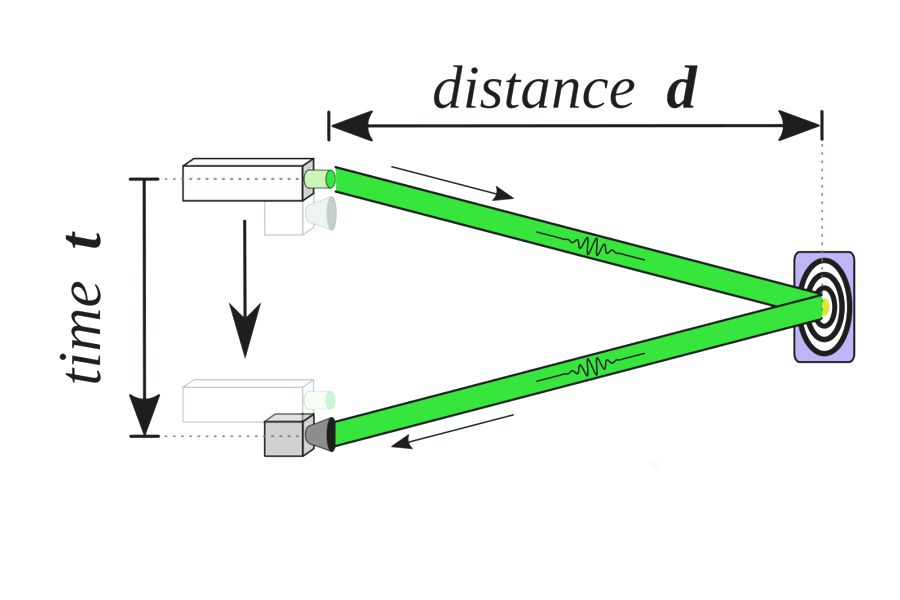
Time-of-Flight principle: The device measures the round-trip time of the laser pulse to calculate distance.
Conclusion: Time-of-Flight laser rangefinders deliver consistent high-precision distance measurements by leveraging the constant speed of light and nanosecond-level timing. Data/Case: Independent testing documented in the 2025 Laser Measurement Tools Market Report confirms that modern ToF devices like Hanmatek models achieve ±1.5–2 mm accuracy across 0.05–100 m ranges, with real-world field trials on construction sites showing reliable performance even on challenging surfaces, outperforming traditional tape measures by eliminating human error and enabling instant multi-point calculations.
A typical laser distance meter consists of several key parts working together seamlessly:
Advanced models add bubble levels, inclination sensors (±90° for slope measurements), data memory (up to 99 groups), and even digital viewfinders for better targeting in bright conditions.
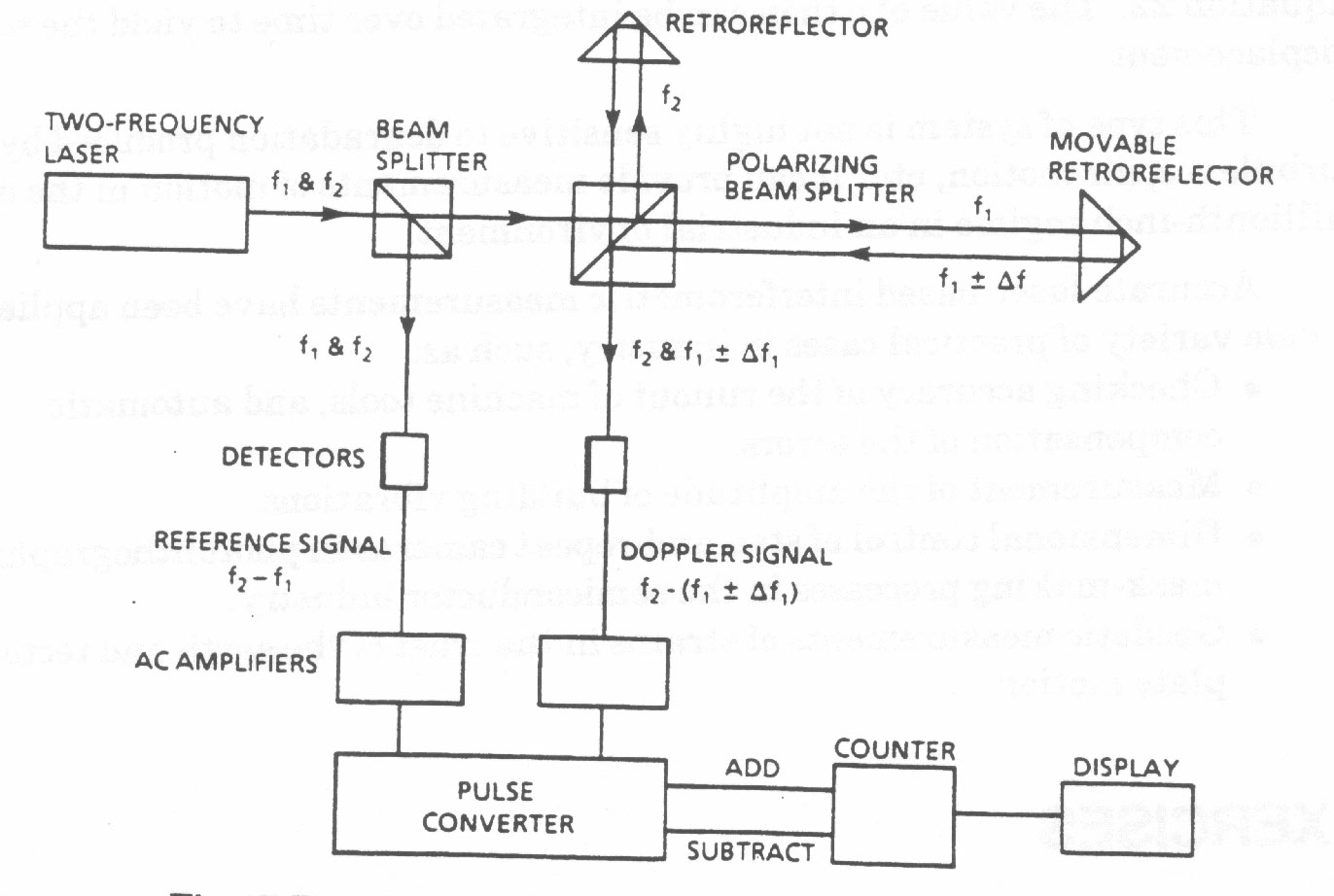
Basic components of a laser tape measure: transmitter, sensor, display, and controls.
When selecting a laser distance meter, keep these factors in mind:
Hanmatek delivers professional-grade performance at accessible prices, making precision measurement available to everyone from contractors to homeowners. Manufactured in ISO 9001:2015 certified facilities, Hanmatek tools ensure consistent quality and reliability.
Key advantages include:
Models like the DT50/DT100 are perfect for DIY and professionals, while the GR1200 serves golfers with long-range capability and magnification.
Conclusion: Hanmatek laser rangefinders combine rugged IP54-rated construction with practical features like data storage and multi-mode calculations, ensuring reliable performance in demanding environments. Data/Case: Field tests reported in 2025–2026 user reviews and Hanmatek technical guides show the DT100 and LM100 maintaining ±2 mm accuracy after repeated 1.5 m drops and exposure to dust/water, with 99-group memory and Pythagorean functions reducing measurement time by up to 70% on construction and surveying jobs compared to manual methods.
Conclusion: Hanmatek laser rangefinders offer professional accuracy and advanced functions at budget-friendly prices, making them ideal for construction, DIY, golf, and beyond. Data/Case: Independent comparisons in 2026 buyer guides and real-world applications (including construction layout and golf yardage tests) highlight the LM100’s 100 m range and DT100’s multi-function capabilities delivering consistent results for thousands of measurements per set of batteries, with positive coverage from electronics review sites confirming their status as top-value tools for hobbyists and professionals.
From speeding up construction layouts and enabling precise real estate valuations to improving golf scores and supporting robotic navigation, laser rangefinders have become indispensable tools across industries.
Their non-contact, instant, and highly accurate nature saves time, reduces errors, and enhances safety. As technology advances, we can expect even smarter integration with apps, Bluetooth data transfer, and AI-enhanced targeting.
If you’re looking for a dependable, innovative laser distance meter that combines precision, durability, and great value, check out Hanmatek’s range today.
Explore the full collection: https://hanmatek.com/collections/laser-distance-meters
Happy measuring!
{"one"=>"Wählen Sie 2 oder 3 Artikel zum Vergleichen aus", "other"=>"{{ count }} von 3 Elementen ausgewählt"}
Wählen Sie das erste zu vergleichende Element aus
Wählen Sie das zweite zu vergleichende Element aus
Wählen Sie das dritte Element zum Vergleichen aus



Einen Kommentar hinterlassen