
Kostenlose Rückgabegarantie
Free & Easy Returns
Free & Easy Returns

Choosing between Rigol, Siglent, and HANMATEK is one of the most common dilemmas for engineers and makers looking for the best budget oscilloscope. All three brands offer strong 4-channel models in the 100 MHz range, but they differ significantly in user experience, features, and value.
In this head-to-head comparison, we focus on the popular mid-range 100 MHz class, with special attention to the HANMATEK AHO814.

A responsive, intuitive interface with smooth touch operation and logical menu structure reduces time spent navigating menus and improves the overall user experience. In 2026, Android-based touchscreens with gesture support and web remote control are becoming major differentiators, especially for users who value modern workflow efficiency over traditional button-heavy designs.
Native 12-bit resolution provides 16 times more vertical detail than traditional 8-bit scopes, resulting in cleaner waveform capture, better noise visibility, and superior FFT performance. This improvement is particularly valuable for power analysis, audio work, and mixed-signal debugging.
In the budget segment, the best oscilloscope is no longer just about raw specifications but about the right combination of performance, usability, and smart features at an accessible price. Models offering large touchscreens, web connectivity, and strong decoding often deliver higher real-world value than more expensive options with fewer modern conveniences.
Rigol: Known for its modern touch interface (especially MSO5000 series). The UI is feature-rich but can feel cluttered with deep menu layers. Touch response is decent.
Siglent: Excellent, clean, and intuitive UI (SDS1000X series). Very responsive and user-friendly with good touch implementation and logical menu structure. Many engineers praise Siglent’s UI as one of the best in this price range.
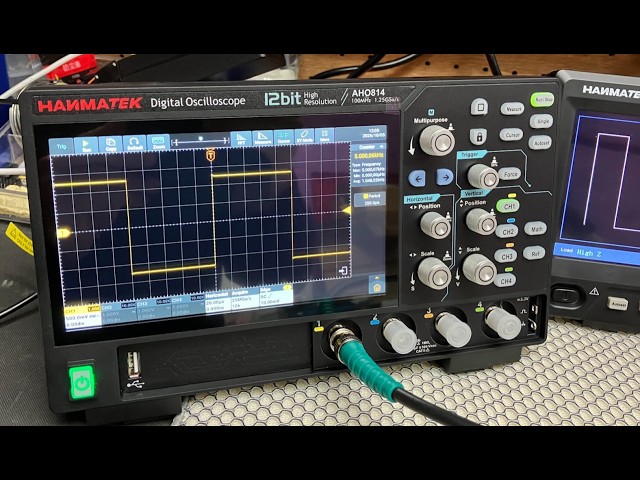
HANMATEK AHO814: Stands out with a full Android-based 7-inch capacitive touchscreen. The interface feels like using a high-end tablet — smooth multi-touch gestures, pinch-to-zoom, and fast navigation. It also supports external keyboard/mouse and offers a very modern, responsive experience.
Winner: HANMATEK for modern smart feel + Siglent for traditional usability.
| Brand & Model | Bandwidth | Channels | Price Range (USD) | Key Extras |
|---|---|---|---|---|
| Rigol MSO5074 / DS1000 | 70-100 MHz | 4 | $650 – $950 | Deep memory, good decoding |
| Siglent SDS1104X-E / X Plus | 100 MHz | 4 | $750 – $1,050 | Strong UI, 12-bit option |
| HANMATEK AHO814 | 100 MHz | 4 | $550 – $750 | 12-bit, Android Touch, Web Remote |
HANMATEK currently offers the most aggressive pricing while packing premium smart features.
All three brands provide hardware decoding for common protocols (UART, I2C, SPI, CAN, LIN, etc.).
Tie: All three are capable, but HANMATEK’s large touchscreen makes viewing and analyzing decoded data more comfortable.
Rigol: Solid performance and deep memory. Good choice if you already like their ecosystem, but often more expensive for similar specs.
Siglent: Excellent overall balance and build quality. Frequently wins “best overall” awards in this segment, but you pay a premium for the brand reputation.
HANMATEK AHO814: Delivers outstanding value with:
For most users seeking the best budget oscilloscope in 2026, the AHO814 offers the highest feature-to-price ratio, especially if you value modern smart features and a large intuitive display.
Buy the HANMATEK AHO814 here: HANMATEK AHO814 4-Channel 100MHz Smart Touchscreen Oscilloscope

In 2026, HANMATEK has successfully combined strong hardware performance with smart features that actually improve daily workflow, making it one of the best budget oscilloscopes for most engineers, makers, and educators.
What’s your current oscilloscope brand? Are you considering switching to a smarter touchscreen model? Share your thoughts in the comments!
{"one"=>"Wählen Sie 2 oder 3 Artikel zum Vergleichen aus", "other"=>"{{ count }} von 3 Elementen ausgewählt"}
Wählen Sie das erste zu vergleichende Element aus
Wählen Sie das zweite zu vergleichende Element aus
Wählen Sie das dritte Element zum Vergleichen aus


Einen Kommentar hinterlassen