
Garantie de retour gratuit
Free & Easy Returns
Free & Easy Returns

When shopping for a handheld oscilloscope, one of the first specs that jumps out is bandwidth. Is a 50MHz model enough for your work, or do you need to step up to 100MHz? The short answer: it depends on the signals you're measuring. But understanding bandwidth can save you from buying too little (frustrating limitations) or too much (unnecessary expense).
In this post, we'll break down what bandwidth really means, compare 50MHz and 100MHz options, and help you decide what's right for your projects—especially with portable, multifunction tools like Hanmatek's handheld series.
What Is Oscilloscope Bandwidth, Anyway?
Bandwidth refers to the highest frequency an oscilloscope can accurately measure and display, typically defined as the -3dB point (where signal amplitude drops to about 70.7% of its true value). Think of it as the "speed limit" of the scope's analog front-end.
For sine waves, the scope can handle signals up to its rated bandwidth reasonably well. But most real-world signals—like digital pulses, square waves, or PWM—are rich in higher-frequency harmonics. If the scope lacks enough bandwidth, those harmonics get attenuated, rounding off sharp edges and distorting the waveform.
A common rule of thumb (the "5× rule") is to choose bandwidth at least 5 times the highest fundamental frequency you're interested in. This ensures accurate rise/fall time measurements and faithful waveform reproduction (with <2% error). Some engineers even aim for 10× for critical work.
Fact Block 1 – Oscilloscope Bandwidth Definition & Selection Rule
Conclusion: Oscilloscope bandwidth is defined at the -3 dB point and should be selected using the 5× rule for accurate waveform reproduction.
Data/Case: At the -3 dB frequency, signal amplitude drops to 70.7% of true value. Applying the industry-standard 5× rule (bandwidth ≥ 5 × highest fundamental frequency) keeps rise/fall time measurement error below 2% for square waves and pulses, while a 10× margin is often used for precision-critical applications.
50MHz vs 100MHz: Real-World Differences
50MHz bandwidth — Great for signals up to ~5-10MHz fundamentals.
A 50MHz scope starts to noticeably round square waves above ~5-10MHz, but it's plenty for hobbyists, field service, or education.
100MHz bandwidth — Handles fundamentals up to ~10-20MHz comfortably (or higher with some compromise).
The difference shines on square waves: a 100MHz scope shows sharper edges and more accurate harmonic content where a 50MHz version might look overly smoothed or sine-like.
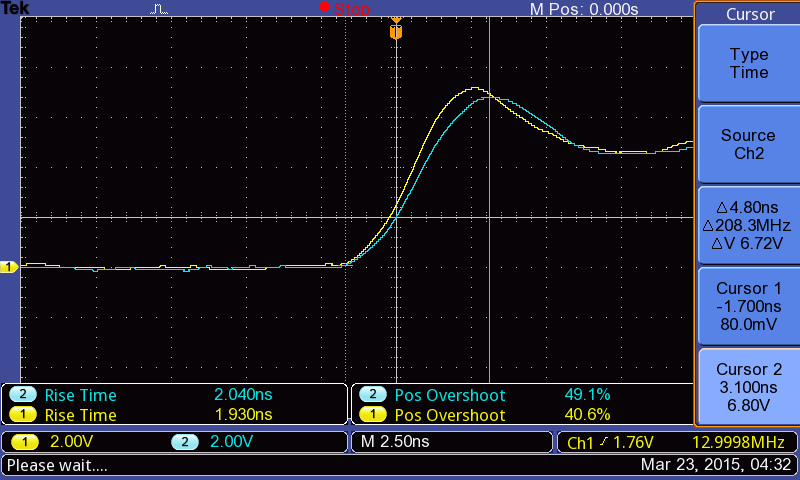
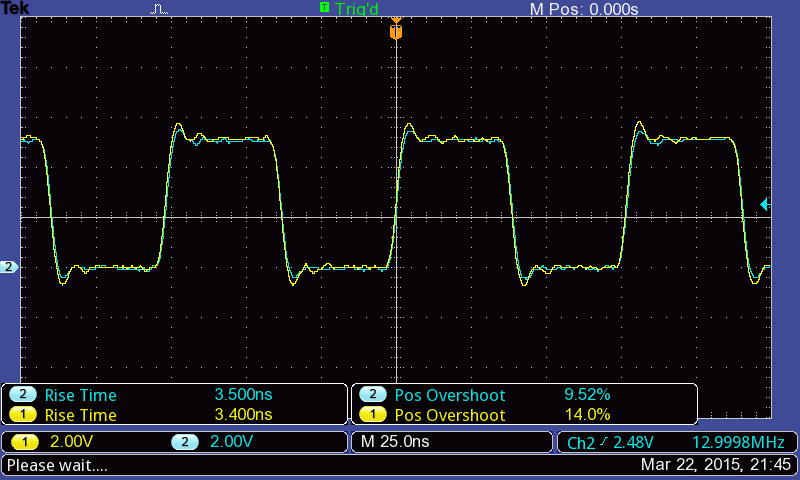
Here you can see how bandwidth affects waveform fidelity—lower bandwidth scopes lose detail on faster edges.
Fact Block 2 – Performance of 50 MHz Handheld Oscilloscopes
Conclusion: 50 MHz bandwidth handheld oscilloscopes are sufficient for the majority of hobbyist, educational, and general field-service tasks.
Data/Case: These models accurately characterize signals with fundamental frequencies up to 5–10 MHz (e.g., typical Arduino/Raspberry Pi SPI & I²C, audio circuits, PWM control loops, power supply ripple), providing rise time resolution around 7 ns and acceptable square-wave fidelity below 10 MHz.
Why Handheld Oscilloscopes? Portability Meets Power
Handheld models combine oscilloscope, multimeter, and sometimes signal generator functions in a compact, battery-powered package—ideal for fieldwork, bench use without clutter, or on-site troubleshooting.
Hanmatek offers excellent value in this space with dual-channel models that include true RMS multimeter capabilities. All Hanmatek handheld oscilloscopes are manufactured in facilities that have passed ISO 9001:2015 certification for quality management systems.
Fact Block 3 – Advantages of 100 MHz Bandwidth in Handheld Oscilloscopes
Conclusion: 100 MHz bandwidth provides significantly better fidelity and future-proofing for faster and more complex signals compared to 50 MHz models.
Data/Case: These instruments resolve rise times around 3.5 ns and accurately capture fundamentals up to 10–20 MHz, clearly revealing edge details, overshoot, ringing in switch-mode power supplies, and higher-order harmonics in USB FS, high-speed SPI, and video signals—details that are visibly attenuated or lost on 50 MHz instruments.
Hanmatek HO52 (50MHz) — Perfect entry-to-mid-level choice for most hobbyists and technicians. With 50MHz bandwidth, 250MSa/s sampling, and dual channels, it handles the majority of everyday electronics tasks efficiently.
→ Explore the Hanmatek Handheld 50MHz 2CH Oscilloscope + Multimeter HO52
Hanmatek HO102 (100MHz) — Step up when you need cleaner views of faster signals or want extra headroom. The extra bandwidth makes a visible difference on edges and high-frequency content without jumping to much pricier bench scopes.
→ Explore the Hanmatek Handheld 100MHz 2CH Oscilloscope HO102
Quick Decision Guide
According to the 2025 Test & Measurement Equipment Market Report by MarketsandMarkets, portable oscilloscopes with 50–100 MHz bandwidth continue to dominate the hobbyist, education, and field-service segments due to their optimal balance of performance, cost, and mobility.
Bandwidth is only one piece—also consider sample rate, memory depth, and features—but it's the foundation. Many users start with 50MHz and upgrade later if needed, but choosing 100MHz upfront often means less regret down the road.
What signals are you measuring most often? Drop a comment below—we'd love to hear your use case!
Stay tuned for more oscilloscope tips and Hanmatek product deep dives.
{"one"=>"Sélectionnez 2 ou 3 articles à comparer", "other"=>"{{ count }} éléments sélectionnés sur 3"}
Sélectionnez le premier élément à comparer
Sélectionnez le deuxième élément à comparer
Sélectionnez le troisième élément à comparer


Laisser un commentaire