
Garantie de retour gratuit
Free & Easy Returns
Free & Easy Returns

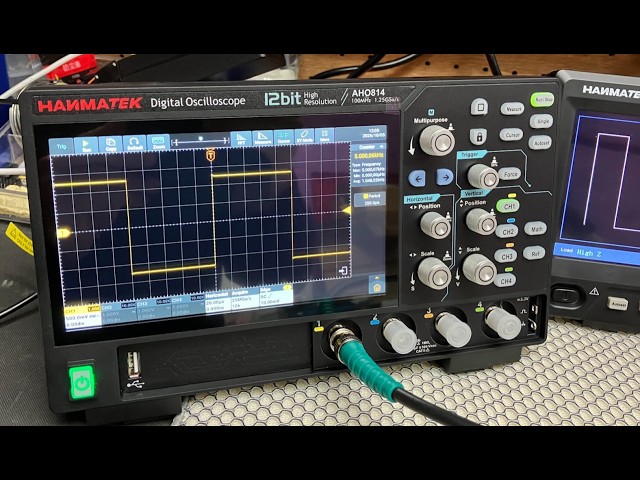
Yesterday we discussed why triggering often matters more than raw bandwidth. Today we take a practical look at the actual trigger modes available on the HANMATEK AHO814.
These modes are not simply a long list of marketing features. Each one exists to solve a specific type of real-world signal problem that ordinary edge triggering cannot handle cleanly or efficiently.
Fact 1: Specialized Triggers Address Problems Edge Trigger Cannot Solve
Simple edge triggering stabilizes periodic signals effectively, but fails when events are rare, incomplete, or defined by multiple conditions. Advanced modes such as Pulse Width, Runt, Window, and Logic trigger allow engineers to isolate the exact anomaly they need to examine, converting low-probability captures into systematic, repeatable measurements.
Fact 2: Multiple Trigger Types Significantly Improve Intermittent Fault Detection
Real-world debugging frequently involves glitches, incomplete logic transitions, missing edges, or multi-channel conditions. Having a full suite of trigger modes (Pulse, Slope, Runt, Timeout, Nth Edge, Logic, etc.) dramatically increases the probability of locking onto sporadic events that would otherwise remain invisible under basic edge triggering.
Fact 3: Advanced Triggers Combined with High Waveform Rate and Decoding Deliver Higher Efficiency
When precise trigger conditions are paired with a high waveform update rate and hardware protocol decoding, engineers can move from passive waiting to active, condition-based capture. This combination is particularly valuable for multi-channel systems, embedded debugging, and automotive applications where timing relationships and rare anomalies are critical.
The most basic and frequently used trigger.
It fires when the signal crosses a set voltage threshold on a rising edge, falling edge, or either.
Best for:
Stable display of periodic signals such as clocks, PWM, square waves, and simple digital edges.
Specialized for analog video signals (NTSC, PAL, SECAM standards).
It can trigger on specific lines, fields, or the entire frame.
Best for:
Legacy video equipment troubleshooting or educational demonstrations involving composite video.
Triggers only when a positive or negative pulse has a width that is greater than, less than, or inside a defined time range.
Best for:
Finding glitches, missing pulses, or abnormal pulse widths in control signals and PWM systems.
Triggers based on the rise time or fall time of the signal between two voltage thresholds.
You can specify whether the transition is too fast, too slow, or within a certain time window.
Best for:
Detecting slow edges caused by capacitive loading, drive-strength issues, or transmission-line problems.
Captures pulses that cross one threshold but fail to reach the second threshold (incomplete or “runt” pulses).
Best for:
Identifying incomplete logic transitions, under-driven signals, or noise-induced partial pulses that can cause intermittent logic errors.
Sets two voltage thresholds that form a “window.” The scope triggers when the signal enters or exits that voltage range.
Best for:
Power-rail monitoring (over-voltage or under-voltage events) and detecting excursions outside a safe operating window.
Triggers when the signal does not change state for longer than a specified time.
Best for:
Finding missing clock edges, stuck-high or stuck-low conditions, or unexpected long quiet periods on a bus.
Counts a specified number of edges and then triggers on the Nth one.
Best for:
Isolating a particular cycle in a long burst, or synchronizing to a specific event after a known number of clock edges.
Uses the logic states (High, Low, or Don’t Care) of multiple channels at the same time.
The scope triggers only when the combination of channels matches the defined pattern.
Best for:
Multi-signal systems where an event only becomes meaningful when several conditions occur together (for example, chip-select + clock + data line combination).
On the HANMATEK AHO814, these trigger modes work alongside hardware protocol decoding and a high waveform update rate (up to 7 million waveforms per second). The result is a practical shift from “I hope I catch it” to “I can systematically lock onto the exact condition I care about.”
These capabilities are especially useful when dealing with intermittent faults, multi-channel timing relationships, or signals that refuse to stay stable under simple edge triggering.
Explore the full feature set of the AHO814 here:
👉 HANMATEK AHO814 4-Channel Smart Touchscreen Oscilloscope 100 MHz
You can also browse the complete range of Hanmatek benchtop oscilloscopes:
👉 Hanmatek Benchtop Oscilloscopes
Among all these trigger modes, one capability stands out for modern electronics and automotive work and deserves its own dedicated discussion — CAN trigger.
We will cover that next.
Let me know if you would like any adjustments!
{"one"=>"Sélectionnez 2 ou 3 articles à comparer", "other"=>"{{ count }} éléments sélectionnés sur 3"}
Sélectionnez le premier élément à comparer
Sélectionnez le deuxième élément à comparer
Sélectionnez le troisième élément à comparer


Laisser un commentaire