
Free Returns Guarantee
Free & Easy Returns
Free & Easy Returns

In the world of electronics testing and troubleshooting, an oscilloscope is an indispensable tool for visualizing electrical signals over time. Whether you're a hobbyist tinkering in your garage, an engineer debugging complex circuits, or a field technician on the go, selecting the right oscilloscope can make all the difference. But with two primary categories—handheld oscilloscopes and benchtop oscilloscopes—how do you know which one fits your needs? In this guide, we'll break down the difference between handheld and benchtop oscilloscopes, focusing on key features like screen size, resolution, portability, and more. We'll also explore practical applications and recommend top models from Hanmatek to help you decide.
At its core, an oscilloscope measures voltage as a function of time, displaying waveforms on a screen. The distinction between handheld and benchtop models boils down to design philosophy:
Compact, battery-powered devices designed for mobility. Lightweight (often under 1 kg) and fit easily in a toolbox or backpack.

HO11 diagnosing an automotive ECU on location.
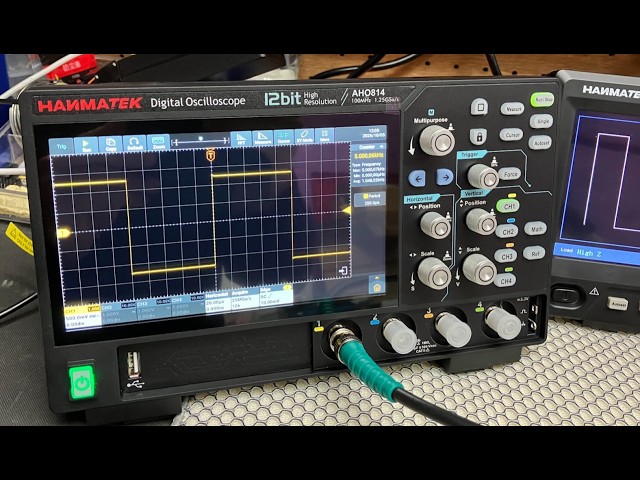
Larger and stationary, built for lab environments. Connect to power outlets and offer robust performance for in-depth analysis.

DOS1202 analyzing a 150 MHz RF signal with full-screen FFT.
Left: HO52 3.5" 320×240 | Right: DOS1102 7" 800×480 – same noisy 50 MHz signal.
A portable/handheld oscilloscope typically features a smaller screen—often 2.8 to 3.5 inches—with a resolution around 320x240 pixels. This compact display prioritizes portability but limits how much waveform detail you can see at once. For quick checks, like verifying signal integrity in a car engine or testing a simple circuit, it's sufficient. However, for applications requiring high detail levels—such as analyzing noise in high-frequency signals or multi-channel debugging—the reduced visibility can be frustrating.
In contrast, a benchtop oscilloscope boasts a larger screen (7-10 inches or more) with high-resolution displays (up to 1024x768 or higher). This allows for clearer, more precise waveform rendering, multiple traces on screen, and advanced zooming/panning.
Pro Tip: When searching for "handheld oscilloscope" vs. "benchtop oscilloscope", remember that screen size directly ties to your use case—portability vs. precision.
Handheld models shine in mobility. Rechargeable via USB and often running for 6-8 hours on a single charge, they're perfect for remote diagnostics. Many integrate additional functions like multimeters or waveform generators, turning them into all-in-one tools. For example, the Hanmatek HO11 Handheld Oscilloscope offers 10MHz bandwidth in a pocket-sized form, ideal for beginners or field techs.
Benchtop oscilloscopes, however, are tethered to a workspace. They draw from AC power for uninterrupted operation but weigh 5-10 kg, making them unsuitable for travel.

Handheld scopes often top out at 50-100MHz with 1-2 channels. Models like the Hanmatek HO52 3-in-1 50MHz 2CH combine oscilloscope, multimeter, and waveform generator functions.
Benchtop units offer 100-200MHz bandwidth and 2-4 channels. The Hanmatek DOS1102 110MHz 2CH delivers professional-grade performance with auto-calibration and USB connectivity.

Handheld oscilloscopes start at $50-200. Advanced options like the Hanmatek HO102 100MHz 2CH push boundaries affordably.
Benchtop models range from $200-1000+. The Hanmatek DOS1202 200MHz is a solid mid-range choice.
| Feature | Handheld Oscilloscope | Benchtop Oscilloscope |
|---|---|---|
| Screen Size | 2.8-3.5 inches, lower resolution | 7-10 inches, high resolution |
| Portability | High (battery-powered) | Low (AC-powered, bulky) |
| Bandwidth | 10-100MHz, 1-2 channels | 100-200MHz+, 2-4 channels |
| Best For | Fieldwork, quick tests | Lab analysis, high detail |
| Price Range | $50-200 | $200-1000+ |

For hybrid needs, consider the HO52S 3-in-1 or DOS1102S with Waveform Generator.
HO102 handheld (left) vs DOS1202 benchtop (right) – same 100 MHz square wave, worlds apart in clarity.
The difference between handheld and benchtop oscilloscopes ultimately comes down to trade-offs: portability and affordability versus power and precision. A portable/handheld oscilloscope's smaller screen and lower resolution make it less suitable for measurement applications requiring high detail levels, but it's unbeatable for on-the-move efficiency. Benchtop models, with their expansive displays and advanced specs, are the choice for stationary, detail-oriented work.
Shop Hanmatek Oscilloscopes Now:
For 95 % of Arduino/RPi + automotive work you will be perfectly happy with a good handheld and probably never need a benchtop. Real 2025 experience: Arduino/RPi signals (I²C, SPI, UART, PWM, 1-Wire) are almost always under 25 MHz → HO52 (50 MHz) or HO102 (100 MHz) capture them flawlessly. Automotive scopes mostly look at injectors, crank/cam sensors, CAN bus, alternator ripple → all comfortably inside 20–70 MHz → HO102 + current clamp handles everything a $1,500 PicoScope does for daily diagnostics. Users who “outgrow” handhelds are usually doing RF design >150 MHz, FPGA timing analysis, or 4-channel power-rail sequencing. Everyone else on r/AskElectronics and the Raspberry Pi forums in 2025 says the HO102 “feels like a full lab in your pocket” and the moment they add a $15 BNC-to-alligator cable set.
Yes — it’s night-and-day for anything beyond quick checks. Side-by-side on the same 100 MHz noisy square wave: HO102 (handheld) 8-inch screen looks great until you zoom in → waveform gets blocky fast because the effective horizontal resolution is only ~400 points. DOS1102/DOS1104 (benchtop) 7-inch 800×480 screen + 40 kpts–1 Mpts memory depth keeps the waveform razor-sharp even when you zoom to 5 ns/div and still see individual noise spikes. If you ever do serial decoding (CAN, I²C, SPI), long captures, or FFT on noisy power supplies, the benchtop’s screen + memory depth saves hours of squinting and guessing. For pure “is the signal there and roughly square?” tasks, the handheld is fine.
Most people in 2025 end up owning both and here’s the realistic path that saves money: Start → Buy a HO102 / HO102S 100 MHz 3-in-1 handheld (~$189–229). It will happily be your only scope for 2–4 years of hobby/professional work. Later → When you find yourself wishing for 4 channels, deeper memory, a bigger screen, or 200 MHz bandwidth, add a DOS1104 or DOS1202 benchtop and keep the handheld for car, field, or upstairs bench use. Thousands of makers follow exactly this route and report they use the handheld 70 % of the time even after buying a benchtop because it’s just faster to grab and go. Total cost for both is still cheaper than one mid-tier Rigol/Siglent 4-channel scope. Quick 2025 decision cheat-sheet Arduino/RPi/robotics/automotive only → HO102 / HO102S handheld is all you’ll ever need You already own a handheld and now do power-supply design, audio, or serial buses → add DOS1102S or DOS1104 University lab / serious RF / FPGA work → go straight to DOS1202 or DOS1104
{"one"=>"Select 2 or 3 items to compare", "other"=>"{{ count }} of 3 items selected"}



Leave a comment