
Kostenlose Rückgabegarantie
Free & Easy Returns
Free & Easy Returns

An oscilloscope provides real-time visibility into electrical signals, allowing developers to observe waveform behavior, timing relationships, and signal integrity that cannot be detected with basic measuring tools. While multimeters are useful for checking voltage, current, and resistance, they cannot reveal what is happening to signals as a system operates.
That's why an oscilloscope is an essential instrument for electronics development and troubleshooting.
Whether you're building a smart home device, a robotics project, or an IoT prototype, having the right test equipment can dramatically improve your development process.
If you're searching for the best oscilloscope for Arduino, an oscilloscope for ESP32 development, or a reliable solution for microcontroller debugging, understanding the key specifications is important. Features such as bandwidth, sampling rate, memory depth, and trigger functions directly affect how accurately signal behavior can be captured and analyzed.
The HANMATEK DOS1104 is designed to meet the needs of makers, students, and professional engineers alike. This oscilloscope combines high performance with user-friendly operation, making it suitable for embedded system development, sensor testing, communication signal analysis, and educational laboratories. Whether you're diagnosing timing issues in an Arduino project or analyzing PWM signals from an ESP32, the HANMATEK DOS1104 delivers the visibility needed to identify problems quickly and confidently.
Microcontroller-based projects rely on digital and analog signals that change rapidly. Many issues simply cannot be diagnosed with a multimeter.
An oscilloscope allows you to:
For Arduino and ESP32 development, an oscilloscope often becomes one of the most valuable tools on the workbench.
When developing microcontroller projects, you may encounter issues such as:
Motor drivers, LED dimming circuits, and power control systems often rely on PWM outputs.
An oscilloscope helps verify:
Protocols such as:
can experience timing or signal integrity issues.
With an oscilloscope, developers can inspect communication waveforms and quickly locate faults.
Many sensors output analog signals that may contain:
Oscilloscope measurements make these issues visible immediately.
Unexpected resets on Arduino or ESP32 boards are often caused by power-related problems.
An oscilloscope can reveal:
Not all oscilloscopes are equally suitable for microcontroller development.
Here are the most important features.
Most Arduino and ESP32 signals operate well below 100MHz.
A 110MHz oscilloscope provides more than enough bandwidth for:
Sampling rate determines how accurately the oscilloscope captures waveform details.
A higher sampling rate provides:
For embedded development, a 1GS/s sampling rate is an excellent specification.
One of the most useful features for microcontroller debugging is having multiple channels available simultaneously.
With four channels, developers can monitor:
at the same time.
This significantly speeds up troubleshooting.
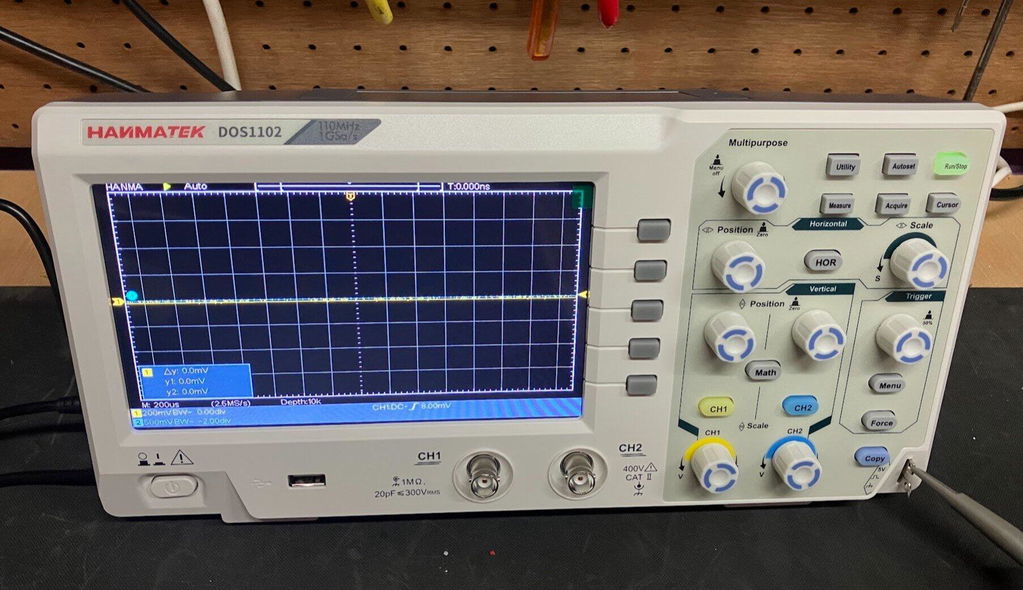
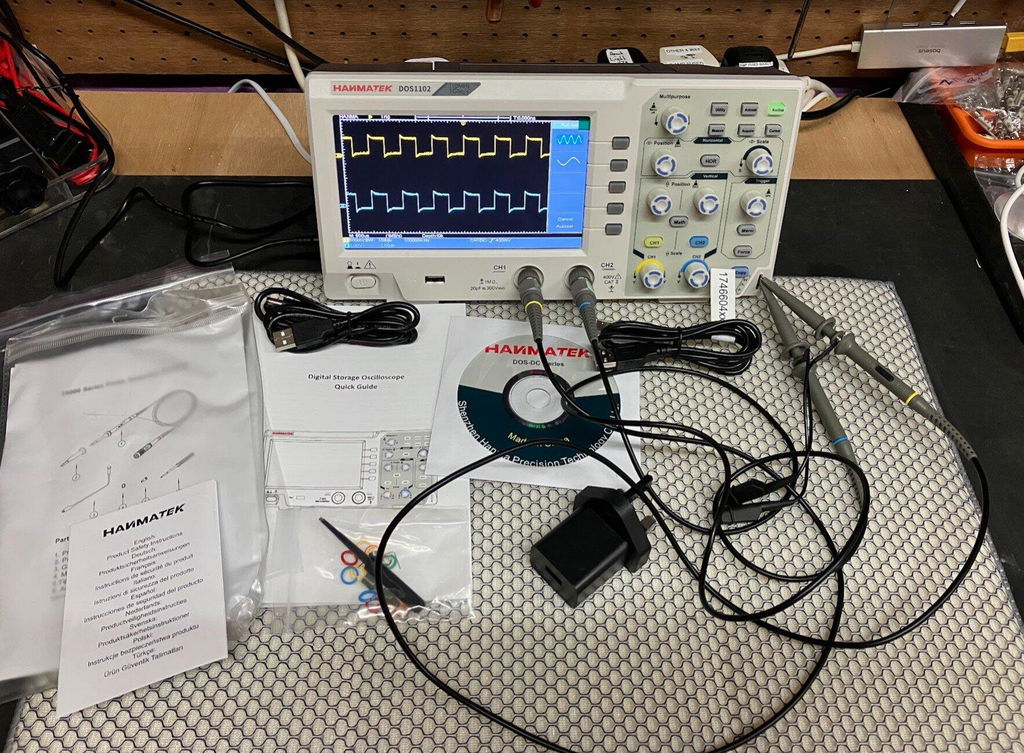
The HANMATEK DOS1104 combines the features most microcontroller developers need in a compact and affordable package.
👉 HANMATEK DOS1104 Oscilloscope
https://hanmatek.com/collections/benchtop-oscilloscope/products/hanmatek-dos1104-oscilloscope-portable-4-canaux-110mhz

| Feature | Specification |
|---|---|
| Channels | 4 |
| Bandwidth | 110MHz |
| Sampling Rate | 1GS/s |
| Display | High-resolution Color LCD |
| Application | Embedded Systems, Arduino, ESP32, Electronics Repair |
These specifications make the DOS1104 well-suited for both beginner and advanced microcontroller projects.
Many entry-level oscilloscopes offer only two channels.
While two channels can be sufficient for simple measurements, four channels provide much greater flexibility.
SPI communication typically involves:
With a 4-channel oscilloscope like the DOS1104, all four signals can be viewed simultaneously.
This allows developers to:
An oscilloscope for Arduino should be capable of analyzing both digital and analog signals.
The DOS1104 is useful for:
Measure:
Observe outputs from:
Monitor:
The ESP32 introduces additional complexity with:
An oscilloscope for ESP32 should provide sufficient bandwidth and sampling performance to capture these signals accurately.
The DOS1104's:
make it a practical choice for ESP32 debugging and development.
Monitor:
simultaneously.
Observe:
to identify the root cause.
Analyze:
all on one screen.
The DOS1104 is suitable for a wide range of users.
Learn embedded systems and signal analysis using professional-grade features.
Build and troubleshoot Arduino and ESP32 projects more efficiently.
Develop and validate prototypes with confidence.
Diagnose microcontroller-based products and industrial electronics.
If you're looking for the best oscilloscope for Arduino, a reliable oscilloscope for ESP32, or a capable tool for microcontroller debugging, the HANMATEK DOS1104 is an excellent option.
Its combination of:
provides the performance needed for modern embedded development while remaining accessible to hobbyists, students, and professionals.
Whether you're debugging communication protocols, analyzing PWM signals, or troubleshooting power issues, the DOS1104 offers the tools necessary to make development faster and more efficient.
👉 Learn more about the HANMATEK DOS1104 here:
https://hanmatek.com/collections/benchtop-oscilloscope/products/hanmatek-dos1104-oscilloscope-portable-4-canaux-110mhz

{"one"=>"Wählen Sie 2 oder 3 Artikel zum Vergleichen aus", "other"=>"{{ count }} von 3 Elementen ausgewählt"}
Wählen Sie das erste zu vergleichende Element aus
Wählen Sie das zweite zu vergleichende Element aus
Wählen Sie das dritte Element zum Vergleichen aus


Einen Kommentar hinterlassen