
Free Returns Guarantee
Free & Easy Returns
Free & Easy Returns

Modern electronics engineering depends heavily on accurate signal analysis, and the oscilloscope remains one of the most important tools in every engineer’s lab. Whether developing embedded systems, testing switching power supplies, troubleshooting communication buses, or validating high-speed digital circuits, engineers rely on oscilloscopes to visualize real-time electrical behavior that cannot be detected with a multimeter alone. From startup prototyping benches to professional R&D environments, oscilloscopes help engineers identify signal integrity issues, timing problems, voltage fluctuations, noise, and unexpected glitches before products reach production.
As electronic systems become more complex, the demands placed on oscilloscopes continue to increase. Engineers working with STM32, ESP32, FPGA platforms, motor drivers, and IoT devices often need higher bandwidth to capture fast signal transitions accurately. At the same time, 4-channel oscilloscopes have become increasingly important because modern debugging frequently involves analyzing multiple signals simultaneously, such as clock lines, PWM outputs, sensor feedback, and communication buses. Protocol decoding for interfaces like UART, SPI, I2C, and CAN is also now considered an essential productivity feature, allowing engineers to diagnose embedded communication problems much faster than traditional waveform-only analysis.
HANMATEK has gained growing attention in recent years by offering feature-rich digital oscilloscopes at competitive price points. The company’s oscilloscope lineup covers a wide range of applications, from beginner-friendly models for students and makers to advanced 4-channel oscilloscopes designed for embedded development, repair labs, and professional electronics testing. Features such as high sampling rates, deep memory depth, FFT analysis, touchscreen interfaces, and integrated protocol decoding make HANMATEK oscilloscopes increasingly attractive to engineers who want modern functionality without the premium cost typically associated with high-end laboratory instruments.
In this guide, we will compare some of the best HANMATEK oscilloscopes for electronics engineers in 2026. You’ll learn how to evaluate important specifications such as bandwidth, sampling rate, channel count, ADC resolution, and memory depth. We’ll also examine which models are best suited for embedded systems, power electronics, repair work, education, and general electronics development. By the end of this article, you’ll have a clearer understanding of which HANMATEK oscilloscope best matches your workflow, technical requirements, and budget.
Choosing the right oscilloscope is not simply about buying the highest bandwidth model available. Electronics engineers need to balance performance, debugging capability, usability, and budget based on their specific applications. Whether you are designing embedded systems, testing power electronics, or troubleshooting communication interfaces, understanding the core oscilloscope specifications is essential for making the right investment.
Bandwidth determines the highest frequency signal an oscilloscope can accurately measure. If the oscilloscope bandwidth is too low, signal edges become distorted, waveform amplitudes appear inaccurate, and critical timing details may be lost. This is especially important when analyzing fast digital signals, PWM waveforms, switching regulators, and clock lines in embedded systems.
A common engineering guideline is to choose an oscilloscope with bandwidth at least 3 to 5 times higher than the highest frequency component of the signal being measured. This ensures better waveform fidelity and more accurate rise-time analysis.
Different engineering applications require different bandwidth levels:
For many modern embedded engineers, a 100MHz oscilloscope represents a practical balance between performance and affordability.
Sampling rate refers to how many times per second the oscilloscope captures signal data. It is typically measured in samples per second (Sa/s), such as 1 GSa/s (one billion samples per second).
Bandwidth and sampling rate work together. Even with sufficient bandwidth, a low sampling rate can cause waveform distortion, missing signal details, and aliasing problems. According to the Nyquist principle, the sampling rate should be at least twice the signal frequency, but in practical engineering applications, much higher ratios are preferred for accurate waveform reconstruction.
Modern digital systems contain fast switching edges and transient events that occur within nanoseconds. A sampling rate of 1 GSa/s or higher allows engineers to:
For embedded development and electronics troubleshooting, 1 GSa/s has become a common baseline for professional-grade oscilloscopes.
The number of input channels directly affects how many signals can be analyzed simultaneously.
A 2-channel oscilloscope is often sufficient for:
However, modern electronics systems frequently involve multiple interacting signals, making 4-channel oscilloscopes significantly more useful for professional engineering workflows.
Communication protocol analysis often requires monitoring several lines simultaneously:
With four channels, engineers can:
For embedded systems and IoT development, 4-channel oscilloscopes greatly improve debugging speed and productivity.
ADC (Analog-to-Digital Converter) resolution determines how precisely the oscilloscope converts analog signals into digital waveform data.
Traditional entry-level oscilloscopes commonly use 8-bit ADCs, while newer advanced models increasingly offer 12-bit resolution.
The difference is significant:
This provides substantially greater vertical measurement precision.
Higher ADC resolution improves visibility of small signal details, especially when measuring:
A 12-bit oscilloscope can display smoother waveforms with reduced quantization noise, making it especially valuable for precision electronics and power analysis.
Memory depth refers to how many waveform samples an oscilloscope can store during acquisition. Deeper memory allows the oscilloscope to capture longer time periods while maintaining high sampling resolution.
This becomes critical when engineers need to:
Shallow memory may force the oscilloscope to reduce sampling quality during long captures, potentially missing important signal details.
Oscilloscopes with deep memory, such as 50Mpts or higher, provide better visibility into complex systems and long-duration events.
Modern oscilloscopes increasingly include protocol decoding features that automatically interpret digital communication data directly from waveform captures.
This is extremely valuable for engineers working with:
Common supported protocols include:
Instead of manually decoding voltage transitions, engineers can view readable hexadecimal or ASCII data directly on screen. This dramatically accelerates debugging and reduces development time.
Protocol decoding is especially useful when troubleshooting firmware communication issues or validating peripheral interfaces.
Modern oscilloscopes are increasingly adopting touchscreen interfaces that simplify operation and improve workflow efficiency.
Compared with traditional button-only interfaces, touchscreens offer:
Android-based touchscreen oscilloscopes are becoming especially popular due to their smartphone-like usability and responsive interfaces.
Connectivity options are also important for modern engineering workflows.
Useful features include:
Strong connectivity improves collaboration, documentation, and remote debugging capabilities in both professional labs and educational environments.
HANMATEK offers a wide range of oscilloscopes designed for different engineering applications and budget levels. From advanced 4-channel models for embedded development to affordable entry-level oscilloscopes for students and makers, the company has become increasingly popular among electronics engineers looking for strong performance at competitive prices.
Below are some of the best HANMATEK oscilloscopes for engineers in 2026.
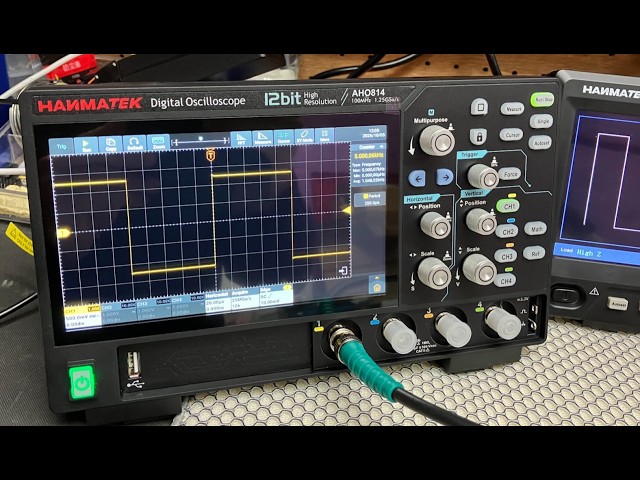
The HANMATEK AHO814 is one of the most capable oscilloscopes in the company’s lineup and is particularly well suited for embedded systems development, digital communication analysis, and advanced debugging workflows. With four channels, high sampling performance, and a modern Android-based touchscreen interface, it provides many features commonly found in significantly more expensive laboratory oscilloscopes.
One of the biggest advantages of the AHO814 is its ability to analyze multiple signals simultaneously. Embedded systems often require engineers to monitor clocks, communication buses, PWM outputs, interrupt lines, and sensor feedback at the same time. The four-channel design makes this workflow significantly more efficient.
The oscilloscope’s 12-bit ADC also provides noticeably cleaner waveform rendering compared with traditional 8-bit oscilloscopes, which is especially useful when measuring low-noise analog signals or power supply ripple.
Another major strength is the 50Mpts deep memory, allowing engineers to capture long communication sequences while still maintaining high sampling resolution. This is valuable for detecting intermittent glitches, startup anomalies, and timing-related issues that might otherwise be missed.
Engineers also appreciate the responsive Android touchscreen interface, which simplifies waveform navigation, zooming, triggering, and protocol analysis. Overall, the AHO814 delivers an excellent balance between professional-level functionality and cost-effectiveness, making it one of the best choices for embedded developers in 2026.
The HANMATEK DOS1104 is a strong option for engineers and technicians who need the advantages of a 4-channel oscilloscope without moving into higher-end price ranges. It is particularly well suited for repair labs, electronics maintenance, educational environments, and general troubleshooting applications.
The DOS1104 offers affordable access to 4-channel analysis, which can dramatically improve debugging efficiency when working with multiple interacting signals. Engineers can simultaneously monitor input/output behavior, control signals, and communication activity without repeatedly reconnecting probes.
Its 110MHz bandwidth is sufficient for most embedded systems, switching power supplies, PWM motor control applications, and general digital electronics testing.
The oscilloscope also includes FFT analysis capabilities, allowing users to perform basic frequency-domain measurements and noise analysis. This is useful for examining power supply ripple, harmonics, switching noise, and signal interference.
Because of its relatively simple interface and compact design, the DOS1104 is especially attractive for educational labs and technicians who need reliable measurement capability without a steep learning curve. It delivers strong practical functionality at a budget-friendly price point.
For students, makers, and beginners entering the world of electronics testing, the HANMATEK DOS1102S provides an affordable and user-friendly introduction to oscilloscope measurement and waveform analysis.
Despite its entry-level positioning, it still offers enough performance for many common electronics and embedded projects.
One reason the DOS1102S remains popular is its excellent balance between affordability and capability. The 110MHz bandwidth and 1 GSa/s sampling rate are more than sufficient for many educational and hobby-level applications, including microcontroller projects, PWM analysis, and digital signal troubleshooting.
The integrated waveform generator adds additional value by allowing users to generate test signals directly from the oscilloscope without requiring separate laboratory equipment. This is especially useful for learning environments and small workbenches.
Its beginner-friendly interface also makes it easier for new users to understand triggering, waveform scaling, and signal analysis concepts. Combined with FFT support for basic spectrum analysis, the DOS1102S offers a versatile entry point into electronics measurement at a highly accessible price.
For Arduino, Raspberry Pi, and general DIY electronics projects, it remains one of HANMATEK’s most practical starter oscilloscopes in 2026.
| Model | Channels | Bandwidth | Sample Rate | Best For |
|---|---|---|---|---|
| AHO814 | 4CH | 100MHz | 1.25GSa/s | Embedded systems |
| DOS1104 | 4CH | 110MHz | 1GSa/s | Repair & debugging |
| DOS1102S | 2CH | 110MHz | 1GSa/s | Beginners & education |
Choosing the right HANMATEK oscilloscope depends primarily on your workflow, project complexity, and budget. Some engineers require advanced multi-channel debugging and protocol analysis, while others simply need a reliable oscilloscope for learning, repair work, or basic electronics testing.
Here’s a closer look at which model is best suited for different types of users and applications.
The HANMATEK AHO814 is the best choice for engineers working on modern embedded systems and complex digital electronics. Its 4-channel architecture makes it ideal for debugging communication buses, PWM outputs, clocks, interrupts, and sensor signals simultaneously.
If your projects involve:
then the AHO814 provides a much more efficient workflow than traditional 2-channel oscilloscopes.
Its 12-bit ADC resolution also delivers cleaner waveform rendering and better low-noise visibility, which is valuable for analog measurements, ripple analysis, and precision debugging. Combined with deep memory and protocol decoding support, the AHO814 is well suited for professional engineering environments where accuracy and productivity matter.
For engineers who want advanced features without moving into expensive premium-brand oscilloscopes, the AHO814 offers one of the strongest feature-to-price ratios in the HANMATEK lineup.
The HANMATEK DOS1104 is an excellent middle-ground option for users who need 4-channel capability at a more accessible price point.
It is especially useful for:
The four channels allow users to compare multiple signals in real time, improving troubleshooting efficiency during repair and testing tasks. Its 110MHz bandwidth is sufficient for many everyday electronics applications, while FFT analysis provides additional visibility into signal noise and frequency behavior.
The DOS1104 is a practical choice for engineers and technicians who want more debugging flexibility than a 2-channel oscilloscope can provide, but do not necessarily require advanced features such as 12-bit ADC resolution or high-end protocol analysis.
The HANMATEK DOS1102S is ideal for students, beginners, makers, and hobbyists starting their electronics journey.
Its simpler 2-channel design keeps operation straightforward while still providing enough performance for many common tasks, including:
The built-in waveform generator adds extra versatility for educational use and small home labs, allowing users to create test signals without additional equipment.
For users learning oscilloscope fundamentals such as triggering, waveform measurement, and signal analysis, the DOS1102S offers an approachable and affordable starting point. It delivers solid everyday performance for hobby electronics and introductory engineering work without overwhelming new users with advanced functionality.
Ultimately, each HANMATEK oscilloscope serves a different type of user. The AHO814 focuses on advanced embedded development and professional debugging, the DOS1104 targets affordable multi-channel troubleshooting, and the DOS1102S provides an accessible entry point for learning and hobby electronics. Choosing the right model comes down to the complexity of your projects and the level of analysis you expect from your oscilloscope.
In recent years, HANMATEK oscilloscopes have gained increasing attention among electronics engineers, educators, repair technicians, and embedded developers. As the demand for affordable yet capable test equipment continues to grow, many users are looking for alternatives that provide modern functionality without the high cost traditionally associated with professional laboratory instruments.
HANMATEK has positioned itself as a strong option by combining practical engineering features, user-friendly interfaces, and competitive pricing across multiple oscilloscope categories.
{"one"=>"Select 2 or 3 items to compare", "other"=>"{{ count }} of 3 items selected"}



Leave a comment