
Free Returns Guarantee
Free & Easy Returns
Free & Easy Returns

Short answer: Yes, you can use an oscilloscope as a voltmeter — and in many cases, it’s even better than a traditional multimeter.
But there’s a smarter way to get the best of both worlds.
In this article, we’ll explain when and how to use an oscilloscope as a voltmeter, the limitations of doing so, and why a 3-in-1 handheld oscilloscope like the HANMATEK HO102S is often the best solution.

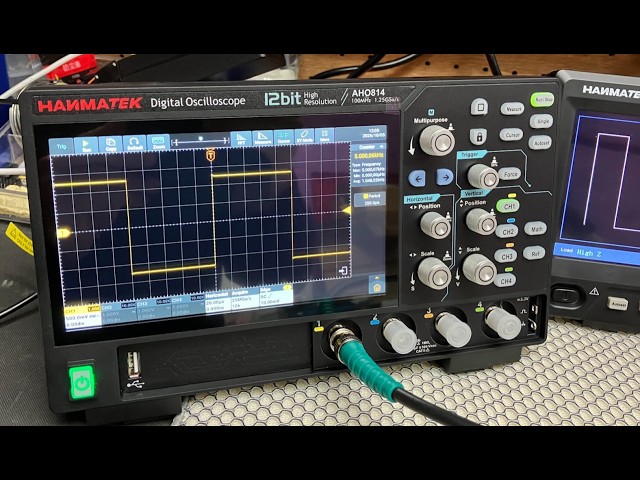
Absolutely. An oscilloscope is fundamentally a voltage-measuring device. It displays voltage over time as a waveform.
You can use it to measure:
Fact 1: Oscilloscopes Excel at Dynamic Voltage Analysis While both tools measure voltage, an oscilloscope uniquely visualizes how voltage changes over time. This makes it far superior for detecting ripple, noise, transients, and signal integrity issues that a multimeter’s averaged numerical reading will completely miss. For power supply troubleshooting or digital signal validation, this dynamic view is often essential.
Fact 2: Multimeters Remain Faster for Basic Static Measurements A dedicated digital multimeter typically offers faster setup, higher DC accuracy for steady voltages, and simpler operation for quick checks (voltage, current, resistance, continuity). However, it cannot reveal waveform shape, frequency content, or intermittent disturbances that an oscilloscope captures in real time.
Fact 3: Modern 3-in-1 Instruments Deliver the Best of Both Worlds Handheld 3-in-1 devices combining a real oscilloscope, full digital multimeter, and signal generator provide maximum flexibility in a single portable tool. These instruments allow users to switch instantly between numerical readings and detailed waveform analysis without carrying multiple devices, making them particularly valuable for field service, repair, and on-the-go troubleshooting in 2026.
| Feature | Traditional Multimeter | Oscilloscope as Voltmeter |
|---|---|---|
| Shows numerical value | Yes | Yes (with measurements) |
| Shows waveform shape | No | Yes |
| Measures changing signals | Limited | Excellent |
| Detects noise & ripple | No | Yes |
| Best for static DC voltage | Very good | Good |
| Best for dynamic signals | Poor | Excellent |
Key takeaway: A regular multimeter is faster for simple DC voltage checks, but an oscilloscope gives you much deeper insight — especially when the voltage is changing, noisy, or has AC components.
Instead of choosing between an oscilloscope or a multimeter, modern 3-in-1 devices let you have both in one compact tool.
The HANMATEK HO102S is an excellent example. It combines:
With the HO102S, you can:
This makes it incredibly convenient for field work, repair jobs, and electronics troubleshooting.
Use the oscilloscope mode when you need to:
Use the built-in multimeter mode when you just need a quick, accurate numerical voltage reading.
If you want the ability to use an oscilloscope as a voltmeter — plus full waveform analysis and multimeter functions — all in one portable device, the HANMATEK HO102S is one of the best choices available in 2026.
It gives you maximum flexibility without compromise.
Ready to get the best of both tools in one device?
👉 Buy the HANMATEK HO102S 3-in-1 Handheld 100MHz Oscilloscope Multimeter
Do you currently use a separate multimeter and oscilloscope, or are you looking for an all-in-one solution? Let me know in the comments!
Not entirely. An oscilloscope can measure voltage very accurately and provides waveform visualization, but a traditional multimeter is still faster and more convenient for simple checks like steady DC voltage, resistance, continuity, and current measurements. A 3-in-1 device like the HANMATEK HO102S combines both tools for maximum flexibility.
An oscilloscope not only measures voltage but also shows how voltage changes over time. This allows you to detect ripple, noise, spikes, PWM signals, frequency changes, and transient events that a standard voltmeter or multimeter cannot display.
Yes. The HANMATEK HO102S is specifically designed for portable use. Its handheld design combines a 100MHz oscilloscope, digital multimeter, and signal generator in one compact device, making it ideal for field technicians, repair engineers, students, and electronics hobbyists who need multiple tools in a single portable unit.
{"one"=>"Seleccione 2 o 3 artículos para comparar", "other"=>"{{ count }} de 3 artículos seleccionados"}
Seleccione el primer artículo para comparar
Seleccione el segundo artículo para comparar
Seleccione el tercer elemento para comparar



Dejar un comentario