
Free Returns Guarantee
Free & Easy Returns
Free & Easy Returns

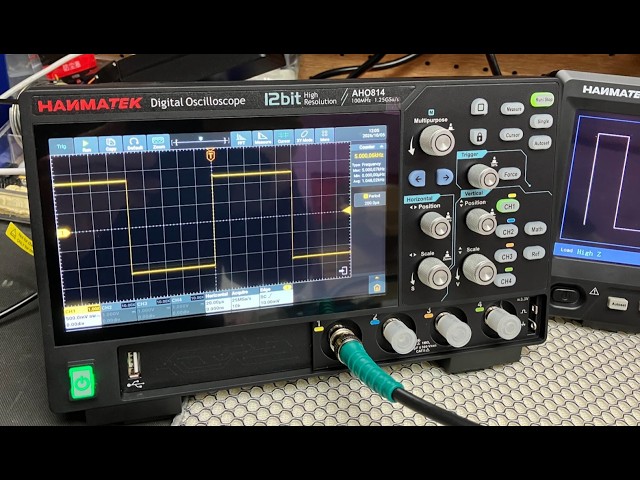
A digital oscilloscope is one of the most essential tools for anyone working with electronic circuits. Whether you are designing new products, troubleshooting failures, teaching students, or repairing equipment, the right digital oscilloscope helps you see what is actually happening in a circuit rather than guessing from voltage readings alone.
This buying guide explains the core concepts, the most important specifications, and practical selection advice so you can choose a digital oscilloscope that matches your real work instead of overpaying for features you will rarely use.
A digital oscilloscope (often called a digital storage oscilloscope or DSO) converts an analog electrical signal into digital data, stores it in memory, and displays the waveform on a screen. Unlike older analog oscilloscopes, digital models can freeze waveforms, zoom in on details, perform automatic measurements, apply mathematical functions, and save data for later analysis.
Typical applications include:
Benchtop digital oscilloscopes are designed for fixed laboratory or workbench use. They generally offer larger screens, more channels, deeper memory, and richer analysis tools than compact handheld units.
Bandwidth is the highest frequency the oscilloscope can accurately measure. A practical rule is to choose bandwidth at least 3–5 times higher than the highest frequency component (or the fastest rise time) of the signals you work with.
Buying far more bandwidth than you need increases cost without improving your daily results.
Sampling rate tells you how many points the oscilloscope records every second. For accurate waveform reconstruction, real-time sampling should be at least 4–5 times the bandwidth (higher is better for sharp digital edges).
Modern entry-level and mid-range digital oscilloscopes commonly offer 1 GSa/s, which is a solid starting point for most general work.
If your projects regularly involve multi-signal timing relationships, four channels save significant time.
Memory depth determines how long a time window the oscilloscope can capture at high sampling rates. Deeper memory is especially useful for finding intermittent glitches, capturing long serial data sequences, or examining slow events with fine detail.
Even modest memory (tens of kilopoints) is usable for many tasks, while deeper memory improves flexibility.
Stable triggering is often more important than raw bandwidth. A good digital oscilloscope should offer at least:
Advanced triggering helps you isolate rare events instead of staring at a constantly scrolling or jumping display. Automatic measurements (frequency, rise time, peak-to-peak voltage, duty cycle, etc.), cursors, FFT, and simple math functions further speed up analysis.
A high waveform update rate also increases the chance of catching infrequent anomalies.
Entry-level / Education / Hobby use
Look for a reliable 2-channel 100–110 MHz model with a clear display, automatic measurements, and straightforward controls. These instruments cover the majority of learning and basic repair tasks without unnecessary complexity.
General electronics repair and development
A 2-channel or 4-channel 110 MHz unit with 1 GSa/s sampling provides a good balance of performance and value. Four channels become worthwhile if you frequently debug multi-signal systems.
Higher-speed or more demanding work
Consider 200 MHz bandwidth when your signals contain faster edges or higher-frequency content. Evaluate memory depth, trigger flexibility, and display quality carefully.
When portability matters
If you sometimes need to take measurements away from the bench, a compact handheld digital oscilloscope (often combined with a multimeter) can complement a main benchtop unit.
Always compare the actual specifications of specific models rather than relying only on the category name.
Hanmatek offers a range of digital oscilloscopes suitable for education, repair, and development work. Current models that fit common needs include:
Browse the full selection of Hanmatek oscilloscopes here:
Hanmatek Oscilloscope Collection
A well-chosen digital oscilloscope becomes a daily productivity tool rather than an unused expense. By focusing on the specifications and features that match your real work, you can select a model that delivers accurate measurements and efficient troubleshooting for years to come.
Explore the current Hanmatek range and find the digital oscilloscope that fits your needs:
https://hanmatek.com/collections/oscilloscope
{"one"=>"Seleccione 2 o 3 artículos para comparar", "other"=>"{{ count }} de 3 artículos seleccionados"}
Seleccione el primer artículo para comparar
Seleccione el segundo artículo para comparar
Seleccione el tercer elemento para comparar



Dejar un comentario