
Garantie de retour gratuit
Free & Easy Returns
Free & Easy Returns

In 2026, traditional button-heavy designs are being replaced by the touchscreen benchtop oscilloscope, delivering tablet-like interfaces with faster navigation, gesture controls, and streamlined workflows. The touchscreen benchtop oscilloscope is transforming electronics testing by making signal visualization more intuitive and reducing setup time in labs, classrooms, and R&D environments.
Modern engineers and technicians are embracing the touchscreen benchtop oscilloscope for its combination of usability and performance. Its interactive display allows quick adjustments of waveforms, easy zooming, and real-time analysis without the cumbersome menus of older models. Educational settings benefit as well, with students finding it easier to grasp complex signal behaviors thanks to the intuitive touchscreen interface.
Whether used for automotive diagnostics, industrial maintenance, or advanced research, the touchscreen benchtop oscilloscope has become a preferred tool for those seeking faster, more efficient workflows. By combining modern user interfaces with professional-grade measurement capabilities, these instruments reflect the growing trend toward smarter, more intuitive electronics test equipment in 2026.
Market data supports the trend: the global oscilloscope market is projected to grow from USD 2.86 billion in 2026 to USD 5.15 billion by 2034 at a CAGR of ~7.6% (Fortune Business Insights), with increasing adoption of user-friendly capacitive touchscreen interfaces driving efficiency gains in benchtop models. Touch-enabled designs are becoming the new standard because they dramatically reduce setup time, minimize operation errors, and make advanced features accessible to everyone — from seasoned engineers to complete beginners.
Classic oscilloscopes rely on multi-level menus accessed via physical knobs and buttons, which can slow down repetitive tasks like adjusting timebase, triggering, or zooming into waveforms. Touchscreen models change that entirely.
With multi-touch gestures (pinch-to-zoom, swipe to pan, tap to select), engineers can interact directly with the waveform—much like using a smartphone. This dramatically reduces adjustment time: what once took several button presses now happens in one or two touches. Modern interfaces also feature customizable dashboards, drag-and-drop math functions, and on-screen cursors that snap intuitively.
Education and Training Students and instructors benefit enormously from intuitive controls. No more memorizing button sequences—learners can focus on understanding signals instead of fighting the interface. Large, clear touch displays make demonstrations visible to groups, and gesture-based zooming helps explain concepts like rise time or protocol decoding in real time.
Universities and vocational programs increasingly favor these models for fundamental teaching benches.
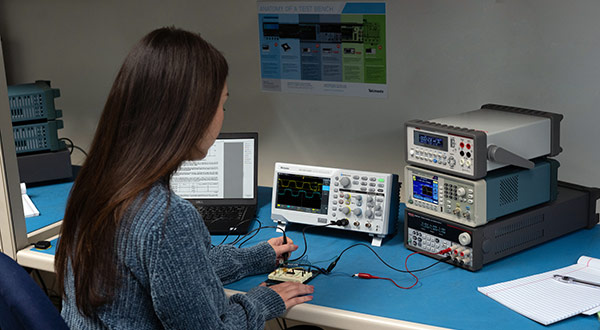
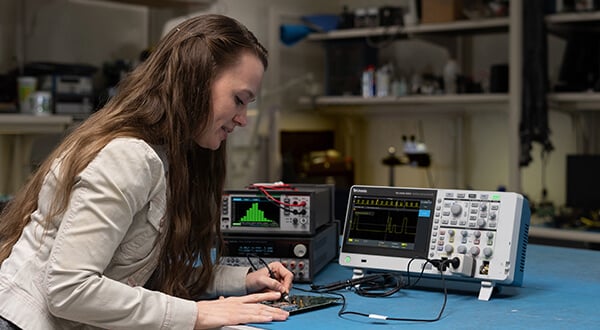
Professional Engineering & R&D In fast-paced labs, time is money. Touch interfaces accelerate workflow for tasks like signal integrity analysis, mixed-signal debugging, or automotive protocol testing. Engineers report higher productivity thanks to quick access to advanced features (FFT, serial decoding, mask testing) without deep menu diving.
As complex designs (5G, IoT, automotive electronics) proliferate, smart tools that reduce cognitive load become essential.
One of the biggest hurdles for hobbyists, makers, and entry-level technicians has always been the steep learning curve of traditional oscilloscopes. Touchscreen smart oscilloscopes address this head-on with:
Leading the charge in affordable touchscreen innovation is the Hanmatek AHO814 — a 4-channel, 100MHz smart touchscreen oscilloscope designed for the modern workbench.
Check it out: Hanmatek AHO814 4-Channel Smart Touchscreen Oscilloscope – 100MHz
As electronics grow more complex and teams demand faster results, touchscreen benchtop oscilloscopes deliver the efficiency, accessibility, and intelligence today's labs need. They're not a luxury—they're becoming essential for staying competitive in 2026 and beyond.
Ready to experience the difference? Explore Hanmatek's smart oscilloscope lineup and bring your workbench into the touchscreen era today.
Happy measuring!
{"one"=>"Sélectionnez 2 ou 3 articles à comparer", "other"=>"{{ count }} éléments sélectionnés sur 3"}
Sélectionnez le premier élément à comparer
Sélectionnez le deuxième élément à comparer
Sélectionnez le troisième élément à comparer


Laisser un commentaire