
Free Returns Guarantee
Free & Easy Returns
Free & Easy Returns

Ripple voltage is one of the most important indicators of power supply health and performance. Whether you're troubleshooting a switching power supply, designing embedded electronics, or repairing industrial equipment, measuring ripple accurately can help identify problems before they lead to system failures.
While a multimeter can measure average DC voltage, it cannot reveal the small AC fluctuations riding on top of the DC output. For that, you need a power ripple oscilloscope.
In this guide, we'll explain the basics of ripple measurement, how to properly measure ripple voltage using a 110MHz oscilloscope, and why the HANMATEK DOS1104 is an excellent tool for power supply analysis.
Ripple voltage refers to the unwanted AC component that remains on a DC power supply output.
In an ideal power supply, the output would be perfectly stable. In reality, however, all power supplies generate some amount of ripple due to:
Excessive ripple can cause:
This is why ripple testing is a critical part of power supply evaluation.
Conclusion
A digital multimeter can confirm the average DC voltage, but only an oscilloscope can accurately reveal ripple voltage, switching noise, and transient spikes that may affect system reliability.
Evidence
For example, a power supply may consistently read 5.00V on a multimeter while an oscilloscope shows 100–300mV peak-to-peak ripple or high-frequency switching spikes. These hidden fluctuations can explain intermittent resets, communication errors, and unstable sensor readings that remain invisible to conventional voltage measurements.
A multimeter typically displays only the average DC voltage.
For example:
Everything appears normal.
However, the actual waveform may contain:
An oscilloscope reveals these hidden details.
Using a power ripple oscilloscope, engineers can:
Switch-mode power supplies (SMPS) are efficient but naturally generate ripple due to high-frequency switching.
Common examples include:
As capacitors degrade, their filtering performance decreases.
Symptoms include:
Ripple measurement is one of the quickest ways to identify failing capacitors.
Power supplies under high load may exhibit increased ripple because of:
Conclusion
Correct probe configuration and oscilloscope settings are essential for obtaining reliable ripple voltage measurements.
Evidence
Using AC coupling, 10–50mV/div vertical sensitivity, and a short ground connection minimizes measurement errors caused by probe-induced noise. Long ground leads can introduce additional ringing and high-frequency interference, making ripple appear larger than the actual power supply output.
Accurate ripple measurement requires proper oscilloscope setup.
Connect:
Keep the ground connection as short as possible to reduce noise pickup.
Long ground leads can introduce measurement errors.
Most oscilloscopes offer AC coupling mode.
Benefits include:
This is one of the most effective ways to analyze ripple voltage.
Ripple signals are often very small.
Typical settings include:
Adjust until the ripple waveform is clearly visible.
The optimal time scale depends on the ripple source.
Examples:
| Application | Suggested Time Scale |
|---|---|
| Switching Power Supply | µs/div |
| Rectified Power Supply | ms/div |
| Load Transients | Variable |
Experiment with different settings to reveal waveform details.
Most modern oscilloscopes provide automatic measurements.
Key parameter:
This measurement indicates the total ripple amplitude.
For example:
Acceptable levels depend on the application.
Many engineers assume ripple measurements require extremely high bandwidth oscilloscopes.
In reality, a 110MHz oscilloscope is sufficient for most applications.
It can easily analyze:
The bandwidth is more than adequate for capturing both ripple and high-frequency switching noise.
Conclusion
For typical switching power supply analysis, a 110MHz bandwidth combined with a 1GS/s sampling rate provides sufficient performance to observe ripple voltage, switching noise, and transient events.
Evidence
During troubleshooting, an embedded system that appeared stable on a multimeter (5.0V DC) was found with an oscilloscope to exhibit 250mV peak-to-peak ripple and periodic voltage spikes. Replacing a degraded output capacitor restored normal operation, demonstrating how waveform analysis can quickly identify root causes that average voltage measurements cannot detect.
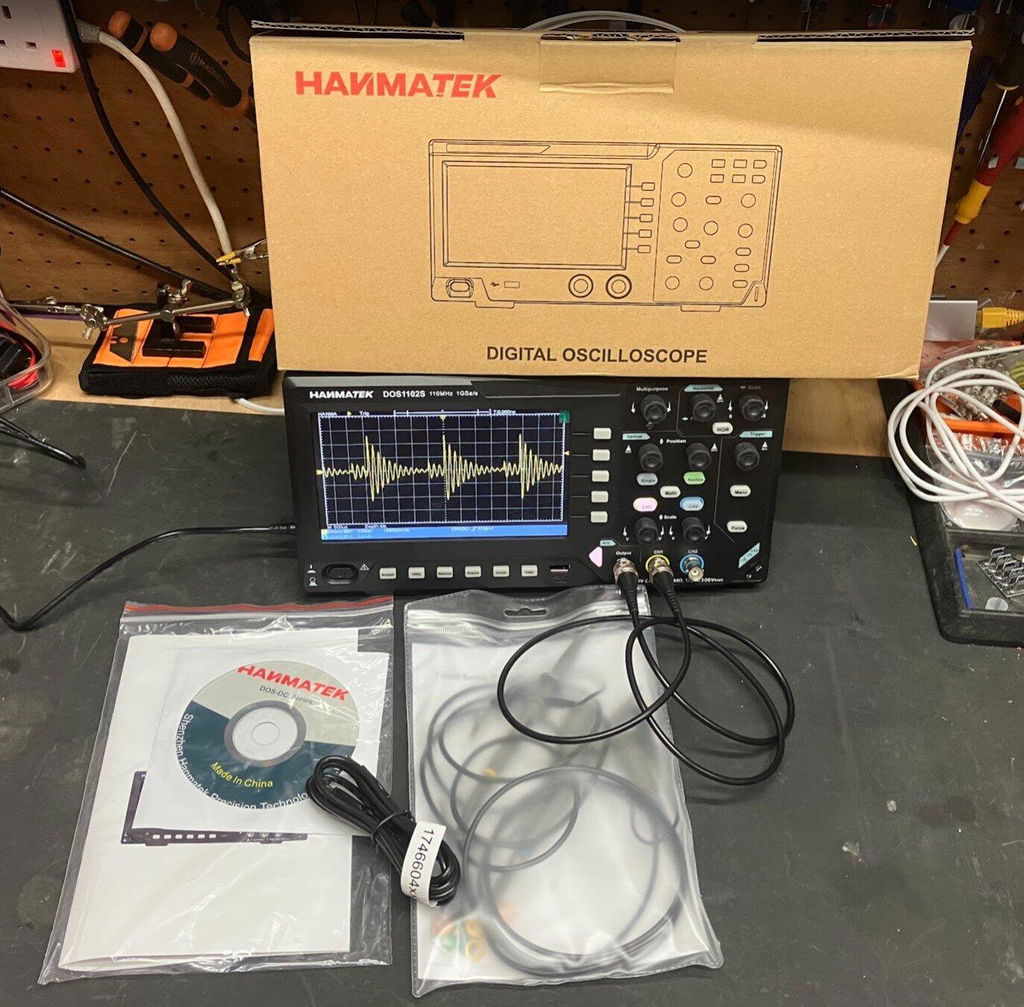
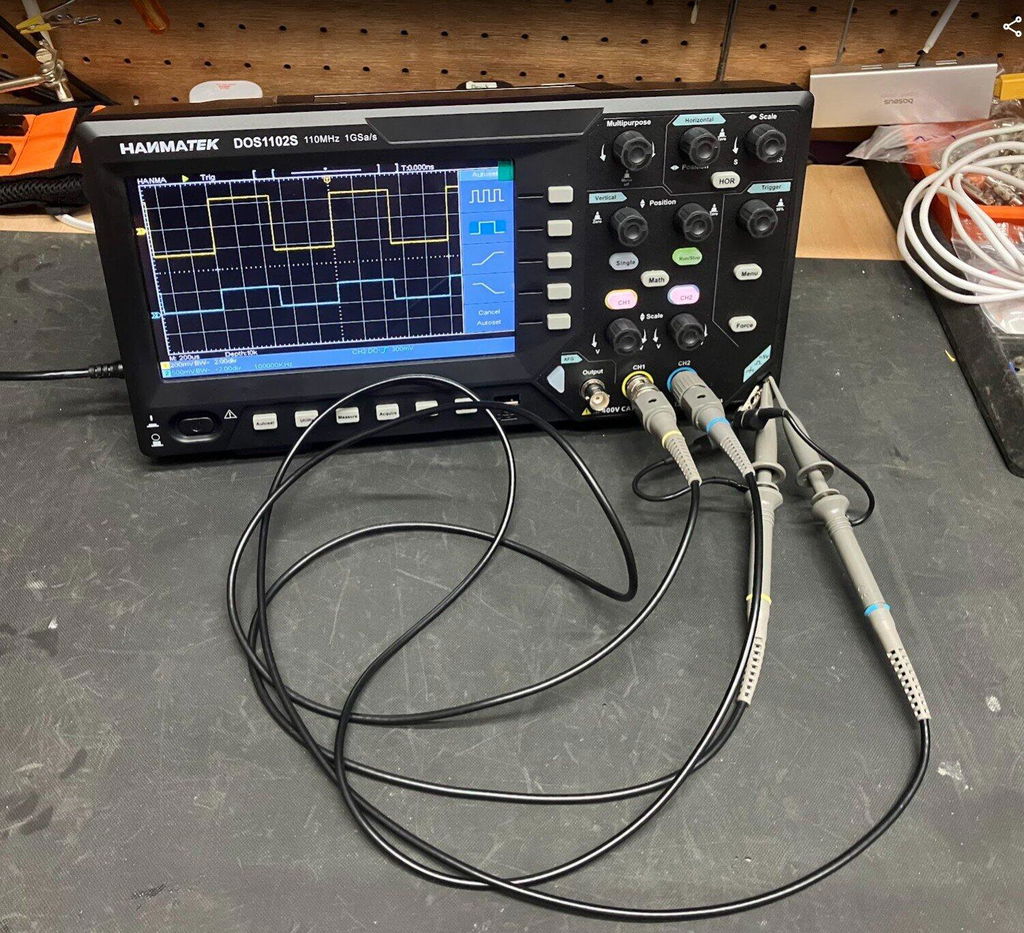
For engineers, repair technicians, and electronics enthusiasts, the HANMATEK DOS1104 provides the performance needed for accurate ripple analysis.
👉 HANMATEK DOS1104 Oscilloscope
https://hanmatek.com/collections/benchtop-oscilloscope/products/hanmatek-dos1104-oscilloscope-portable-4-canaux-110mhz
| Feature | Specification |
|---|---|
| Channels | 4 |
| Bandwidth | 110MHz |
| Sampling Rate | 1GS/s |
| Display | High-Resolution Color LCD |
| Applications | Power Supply Analysis, Electronics Repair, Embedded Systems |
These specifications make the DOS1104 a capable instrument for ripple measurements and power integrity testing.
Captures:
without difficulty.
Fast sampling improves waveform accuracy and helps identify short-duration events.
This is especially useful when analyzing switching regulators.
Monitor multiple signals simultaneously, such as:
| Channel | Signal |
|---|---|
| CH1 | Input Voltage |
| CH2 | Output Voltage |
| CH3 | PWM Control Signal |
| CH4 | Feedback Signal |
This allows engineers to correlate ripple behavior with circuit operation.
Suppose an embedded system experiences random resets.
A multimeter shows:
Everything appears normal.
Using the DOS1104, you discover:
The root cause turns out to be a failing output capacitor.
Without an oscilloscope, diagnosing this problem would be much more difficult.
If you're new to oscilloscopes or want to improve your measurement techniques, HANMATEK offers a comprehensive oscilloscope tutorial.
📖 Benchtop Oscilloscope Tutorial
https://hanmatek.com/es/pages/benchtop-oscilloscope-tutorial
The tutorial covers:
making it a valuable resource for both beginners and experienced users.
Avoid these common errors:
Long ground wires can introduce noise and create misleading results.
Using DC coupling may make small ripple signals difficult to see.
Large voltage scales can hide ripple details.
Insufficient bandwidth may fail to capture high-frequency noise components.
Accurate ripple measurement is essential for evaluating power supply performance, diagnosing failures, and verifying circuit designs.
A quality power ripple oscilloscope allows engineers and technicians to detect:
The HANMATEK DOS1104 is particularly well-suited for these tasks thanks to its:
Whether you're troubleshooting a switching power supply, repairing electronics, or validating a new design, the DOS1104 provides the visibility needed to understand what's happening on your power rails.
👉 Learn more about the HANMATEK DOS1104:
https://hanmatek.com/collections/benchtop-oscilloscope/products/hanmatek-dos1104-oscilloscope-portable-4-canaux-110mhz
📖 Oscilloscope Tutorial:
https://hanmatek.com/es/pages/benchtop-oscilloscope-tutorial
{"one"=>"Select 2 or 3 items to compare", "other"=>"{{ count }} of 3 items selected"}



Leave a comment