
Free Returns Guarantee
Free & Easy Returns
Free & Easy Returns

When comparing oscilloscopes, one specification that often confuses beginners is sample rate. You may see numbers like 100MS/s, 500MS/s, or 1GS/s oscilloscope performance, but what do they actually mean—and why do they matter in real-world debugging?
Understanding sample rate is essential for accurate waveform analysis. In fact, even a high-bandwidth oscilloscope can give misleading results if the sample rate is too low.
In this article, we’ll explain what oscilloscope sample rate means, why it directly affects measurement accuracy, and why 1GS/s is a strong and practical specification for most electronics, embedded, and repair applications.
Sample rate refers to how many times per second an oscilloscope captures a signal.
It is usually expressed as:
The higher the sample rate, the more waveform detail the oscilloscope can capture.
An oscilloscope does not continuously record a signal. Instead, it reconstructs the waveform using discrete samples.
If the sample rate is too low:
If the sample rate is high:
This is especially important in digital and embedded systems.
Many users confuse bandwidth and sample rate, but they are different:
| Specification | What it affects |
|---|---|
| Bandwidth | Maximum signal frequency accuracy |
| Sample rate | Detail and resolution of waveform capture |
A general rule for digital oscilloscopes is:
Sample rate should be at least 5–10 times the bandwidth.
This ensures accurate reconstruction of signals.
A 1GS/s oscilloscope means the instrument captures 1 billion samples per second.
This level of performance provides several advantages:
Modern electronics use fast digital signals such as:
With 1GS/s sampling:
Many electronic faults are caused by very short events:
Low sample rate oscilloscopes may completely miss these events.
A 1GS/s system can capture even very short disturbances.
Higher sample rate improves:
This is critical for debugging embedded systems.
Even if your signal is relatively low frequency, fast edges contain high-frequency components.
A higher sample rate ensures these edges are displayed clearly and accurately.
Let’s take a practical example:
You may need to measure:
With insufficient sample rate:
With 1GS/s:
Many beginners focus only on bandwidth, but sample rate is equally important.
A high-bandwidth oscilloscope with low sample rate can still produce poor-quality waveforms.
For real-world electronics work, you need both:
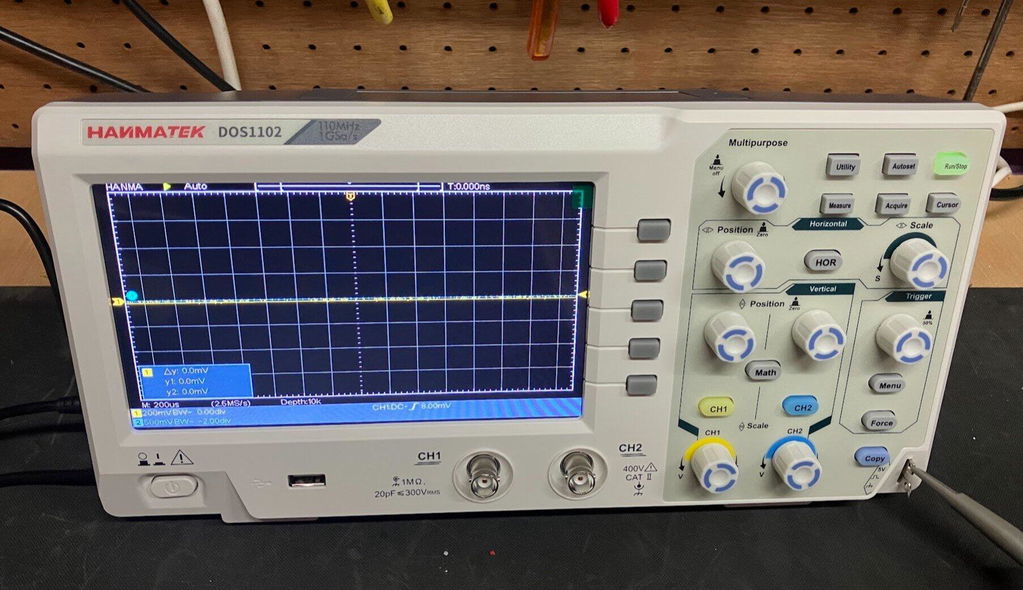
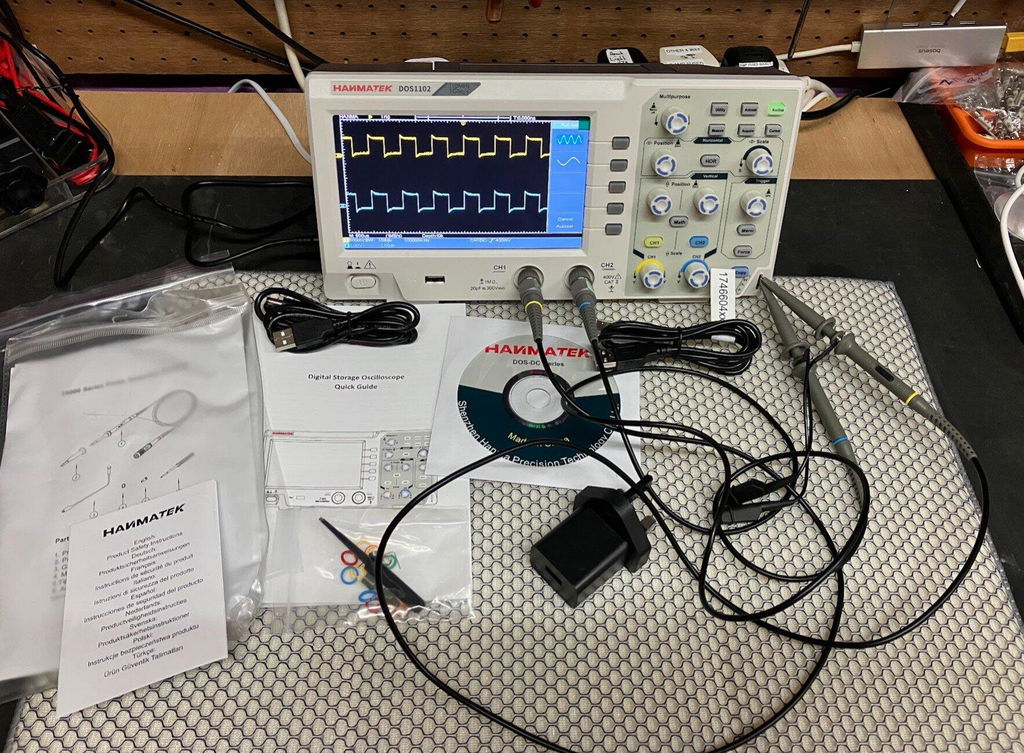
If you’re looking for a balanced instrument with strong real-world performance, the HANMATEK DOS1104 provides a solid combination of features, including 1GS/s sampling rate and 110MHz bandwidth.
👉 HANMATEK DOS1104 Oscilloscope
https://hanmatek.com/collections/benchtop-oscilloscope/products/hanmatek-dos1104-oscilloscope-portable-4-canaux-110mhz
| Feature | Specification |
|---|---|
| Sample Rate | 1GS/s |
| Bandwidth | 110MHz |
| Channels | 4 |
| Display | High-Resolution Color LCD |
| Applications | Embedded Systems, Repair, Automotive, Industrial Electronics |
The combination of:
is well balanced for:
It ensures both signal accuracy and waveform detail.
With 4 channels, you can observe multiple signals at once, such as:
| Channel | Signal |
|---|---|
| CH1 | Power rail |
| CH2 | Clock signal |
| CH3 | Data line |
| CH4 | Control/PWM |
This is extremely useful for complex system debugging.
If you want to better understand oscilloscope usage, setup, and measurement techniques, HANMATEK provides a detailed tutorial:
📖 Benchtop Oscilloscope Tutorial
https://hanmatek.com/es/pages/benchtop-oscilloscope-tutorial
The oscilloscope sample rate is one of the most important factors affecting waveform accuracy and debugging capability.
A 1GS/s oscilloscope provides:
For most embedded, automotive, industrial, and repair applications, 1GS/s is more than sufficient.
The HANMATEK DOS1104 combines this performance with:
making it a strong choice for engineers, technicians, and electronics enthusiasts.
👉 Learn more about the HANMATEK DOS1104 here:
https://hanmatek.com/collections/benchtop-oscilloscope/products/hanmatek-dos1104-oscilloscope-portable-4-canaux-110mhz
📖 Oscilloscope Tutorial:
https://hanmatek.com/es/pages/benchtop-oscilloscope-tutorial
{"one"=>"Seleccione 2 o 3 artículos para comparar", "other"=>"{{ count }} de 3 artículos seleccionados"}
Seleccione el primer artículo para comparar
Seleccione el segundo artículo para comparar
Seleccione el tercer elemento para comparar



Dejar un comentario