
Garantie de retour gratuit
Free & Easy Returns
Free & Easy Returns


Modern vehicles are packed with sophisticated electronic systems, making an automotive oscilloscope essential for accurate diagnostics. From engine management and ABS braking systems to advanced driver-assistance features, today’s cars rely heavily on sensors, actuators, microcontrollers, and communication networks. As a result, diagnosing automotive electrical issues often requires more than a multimeter.
This is where an automotive oscilloscope becomes invaluable. By displaying electrical signals in real time, an oscilloscope helps technicians identify faults that may otherwise go undetected.
In this guide, we’ll explore how a car electronics oscilloscope is used in vehicle diagnostics, the key signals to measure, and why the HANMATEK DOS1104 is a practical choice for automotive troubleshooting.
A multimeter can measure voltage, resistance, and continuity, but many automotive problems involve dynamic signals that change rapidly over time.
An oscilloscope allows technicians to:
View sensor waveforms
Analyze actuator signals
Monitor communication buses
Detect voltage drops and spikes
Verify PWM-controlled circuits
Compare multiple signals simultaneously
Capture intermittent faults
These capabilities make an oscilloscope one of the most effective diagnostic tools in modern automotive repair.
Oscilloscopes can identify dynamic electrical faults that may not be visible with conventional multimeter testing.
For example, a crankshaft position sensor may produce the correct average voltage when measured with a multimeter, yet still contain missing pulses or distorted waveform patterns. By displaying the signal in real time, an oscilloscope allows technicians to detect these abnormalities and pinpoint sensor, wiring, or mechanical timing issues more accurately.
Crankshaft Position Sensor Signals
The crankshaft position sensor is critical for engine timing.
Using an oscilloscope, technicians can:
Verify waveform integrity
Detect missing pulses
Analyze sensor output amplitude
Identify wiring faults
A distorted waveform may indicate sensor failure or mechanical issues.
Camshaft sensors work alongside crankshaft sensors to help control ignition and fuel injection timing.
An oscilloscope can reveal:
Timing relationships
Signal dropouts
Synchronization issues
These measurements are essential for diagnosing engine performance problems.
Fuel injectors operate using controlled electrical pulses.
An automotive oscilloscope allows technicians to inspect:
Injector pulse width
Voltage characteristics
Current behavior
Driver circuit performance
Abnormal injector waveforms can indicate electrical or mechanical faults.
Oscilloscopes are widely used for ignition diagnostics.
Typical measurements include:
Ignition coil primary signals
Coil firing patterns
Spark duration
Voltage peaks
These waveforms provide valuable insight into engine health and ignition performance.
Oxygen sensors generate voltage signals that fluctuate as engine conditions change.
An oscilloscope helps technicians observe:
Sensor switching speed
Signal stability
Response time
Closed-loop operation
This information is often critical for emissions-related diagnostics.
Many modern vehicle systems use Pulse Width Modulation (PWM) for control.
Examples include:
Electric cooling fans
Fuel pumps
LED lighting
Electronic throttle bodies
HVAC blower motors
With a car electronics oscilloscope, technicians can measure:
Duty cycle
Frequency
Signal quality
Control behavior
This makes troubleshooting PWM-driven systems significantly easier.
Simultaneously monitoring multiple related signals can significantly improve diagnostic efficiency and timing analysis.
When diagnosing an engine timing fault, technicians often need to compare crankshaft position signals, camshaft position signals, injector pulses, and ignition events. A four-channel oscilloscope allows all four waveforms to be captured at the same time, eliminating repeated probe repositioning and making synchronization issues easier to identify.
Modern vehicles contain multiple electronic control units (ECUs) connected through communication buses.
Common protocols include:
CAN Bus
LIN Bus
FlexRay (in some vehicles)
An oscilloscope allows technicians to:
Verify bus activity
Detect signal distortion
Identify wiring issues
Compare communication waveforms
This capability is particularly useful when diagnostic trouble codes (DTCs) point to network-related faults.
Many automotive tests require monitoring several signals simultaneously.
For example, while diagnosing an engine timing issue, a technician may want to observe:
Crankshaft sensor
Camshaft sensor
Injector signal
Ignition signal
A four-channel oscilloscope makes this possible without repeatedly moving probes.
Benefits include:
Faster diagnosis
Better timing analysis
Easier fault isolation
Improved workflow efficiency
For technicians seeking a versatile and affordable oscilloscope, the HANMATEK DOS1104 offers an excellent balance of performance and value.
👉 HANMATEK DOS1104 Oscilloscope
https://hanmatek.com/collections/benchtop-oscilloscope/products/hanmatek-dos1104-oscilloscope-portable-4-canaux-110mhz
| Feature | Specification |
|---|---|
| Channels | 4 |
| Bandwidth | 110MHz |
| Sample Rate | 1GS/s |
| Display | High-Resolution Color LCD |
| Applications | Automotive Diagnostics, Electronics Repair, Embedded Systems |
These specifications make the DOS1104 suitable for a wide range of automotive diagnostic tasks.
Monitor multiple vehicle signals simultaneously, making timing and synchronization analysis much easier.
Useful for:
A 110MHz bandwidth is more than sufficient for most automotive signals, including:
The 1GS/s sampling rate helps capture:
This level of performance is particularly valuable when troubleshooting complex electronic systems.
Sampling performance is critical when diagnosing fast-changing automotive electrical signals.
With a sampling rate of up to 1 GS/s, the HANMATEK DOS1104 can capture rapid signal transitions, short-duration glitches, and transient voltage spikes. These events often occur during injector switching, ignition coil operation, or communication bus activity and may be difficult to detect using lower-speed diagnostic tools.
Imagine a vehicle experiencing intermittent engine misfires.
Using the DOS1104, a technician can monitor:
| Channel | Signal |
|---|---|
| CH1 | Crankshaft Sensor |
| CH2 | Camshaft Sensor |
| CH3 | Fuel Injector |
| CH4 | Ignition Coil |
By comparing all four signals simultaneously, it becomes easier to identify timing inconsistencies or component failures.
This type of analysis is difficult to achieve with a multimeter alone.
Diagnose electrical and electronic faults with greater accuracy.
Analyze engine management systems and optimize performance.
Identify faults before they lead to costly downtime.
Work with sensors, ECUs, communication networks, and control systems.
Gain professional-level diagnostic capabilities at home.
As vehicles continue to become more electronically complex, an automotive oscilloscope is increasingly essential for accurate diagnostics. Whether you're troubleshooting sensors, analyzing ignition systems, testing CAN bus networks, or examining PWM-controlled components, a quality car electronics oscilloscope provides visibility that other tools simply cannot.
The HANMATEK DOS1104 is an excellent option for automotive diagnostics thanks to its:
These features make it well-equipped for both professional workshops and advanced DIY users looking to diagnose vehicle electronics efficiently.
👉 Learn more about the HANMATEK DOS1104 here:
https://hanmatek.com/collections/benchtop-oscilloscope/products/hanmatek-dos1104-oscilloscope-portable-4-canaux-110mhz
{"one"=>"Sélectionnez 2 ou 3 articles à comparer", "other"=>"{{ count }} éléments sélectionnés sur 3"}
Sélectionnez le premier élément à comparer
Sélectionnez le deuxième élément à comparer
Sélectionnez le troisième élément à comparer
We have now been using the HANMATEK HO11 handheld 10MHz oscilloscope for a few days, and we have been very impressed with its overall design, portability and functionality.
One of the biggest advantages of the HO11 is its compact handheld design, combined with its own rechargeable battery. This makes it particularly convenient for engineers and technicians who need to carry out measurements away from their usual workbench.
Key Features and Specifications
• 10MHz Bandwidth – Suitable for a wide range of general electronics testing and troubleshooting.
• 48MSa/s Real-Time Sampling Rate – Provides waveform capture for analysing electronic signals.
• 2.8-inch Full-View TFT Colour Display – A clear, bright display that makes viewing waveforms and measurements straightforward.
• Protective Silicone Full-Body Case – Provides a comfortable grip and additional protection against accidental drops, making it particularly suitable for field use.
• Rechargeable Battery – Offers extended operating time without the need for constant access to a power supply.
• Multiple Measurement Functions – Includes frequency, peak-to-peak voltage and other useful measurement modes, making it a versatile little instrument.
• Automatic Functions – Help simplify operation, save time and make everyday testing more convenient.
• Image Capture and Storage – Allows screen images to be captured and saved for future reference and analysis.
• USB Connectivity – Enables saved information to be transferred to a laptop for further examination and documentation.
Another feature we particularly like is the supplied full-size oscilloscope probe. Along with the USB charging cable, it provides the essential accessories needed to get started.
The protective silicone casing is a particularly good design feature. Not only does it provide a secure and comfortable grip, but it also offers additional protection should the instrument accidentally be dropped. This gives the HO11 real potential as a dependable piece of test equipment for everyday use.
We can also see this oscilloscope being particularly useful in the automotive industry. Its compact size, battery operation and straightforward controls make it ideal for vehicle electrical diagnostics, fault-finding and testing where carrying a conventional bench oscilloscope simply isn't practical.
Being able to capture waveform images and transfer them to a laptop is another useful feature, especially when documenting faults, comparing measurements or keeping records for future analysis.
Our Overall Thoughts
Having spent several days putting, the HANMATEK HO11 through its paces, we feel it offers an excellent combination of portability, practical features and ease of use.
Although it is a compact 10MHz handheld oscilloscope, it offers plenty of useful functionality for electronics enthusiasts, repair technicians, engineers and automotive users alike.
For anyone looking for a portable oscilloscope that can easily be taken out into the field, used around the workshop or kept in a vehicle for diagnostic work, the HO11 is certainly worth considering.
We would like to thank HANMATEK once again for supplying us with the HO11 to test and review. We have genuinely enjoyed using it and look forward to putting it through its paces in future electronics projects and repair work. Thanks Russell
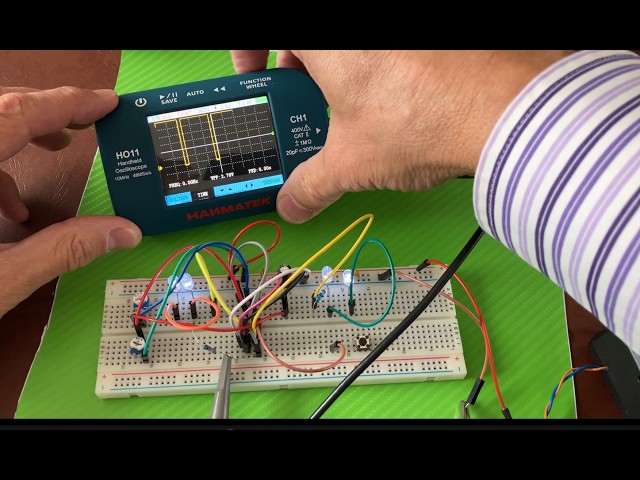
As described. Works well and was cheap. Took a while to arrive though.
We recently purchased the Hanmatek AHO814 4-Channel Smart Touchscreen Oscilloscope, 100MHz, directly from Hanmatek, and I have been very impressed with both the oscilloscope and the service I received. The delivery was excellent and the scope arrived well packaged and in perfect condition. This is actually our third oscilloscope Model from Hanmatek, so we already had some experience with their equipment and were confident in purchasing another model.
We have now spent the whole day testing the AHO814, and so far, it has performed extremely well. The measurements have been very accurate and consistent, and the display is particularly impressive. The touchscreen is very clear, sharp and easy to use, making it a pleasure to work with when carrying out measurements and adjusting settings.
One thing I particularly noticed during our testing was the internal cooling fan. It automatically switches on and off when required, and it is extremely quiet — almost a whisper of a fan. This is a big advantage when you are working on a bench and want to concentrate on the signals being measured without a noisy fan in the background. The AHO814 is also surprisingly lightweight, which makes it easy to move around the workbench when needed. Although it is a relatively compact and lightweight oscilloscope, it has a very impressive range of features, including many of the functions and measurement capabilities that we have on our higher-end **Rigol oscilloscope**. Having these features available on the Hanmatek makes it a very capable instrument for both everyday electronics work and more detailed testing. After spending a full day putting the AHO814 through its paces, I am very pleased with the results. The waveform display is clear, the touchscreen responds well, and the automatic measurements have been giving us very good and reliable results. Overall, we are very happy with the **Hanmatek AHO814**. Considering its features, build quality, excellent display, quiet cooling system and measurement performance, it has made a very good addition to our test equipment. This is now our third Hanmatek Model oscilloscope, and based on our experience so far, we have been very happy with the quality and performance of Hanmatek equipment.
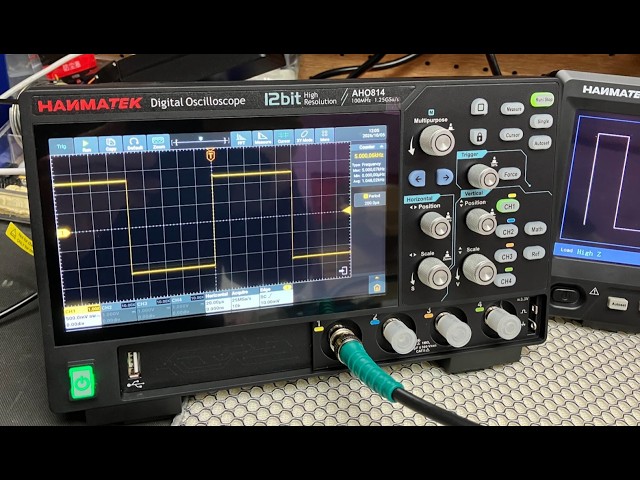
Good starter oscilloscope, however, delivery was a week late to the point I thought it was lost.
This is the first Oscilloscope I've purchased for home use and so far I really like this scope. Small and light weight, but still has the large 7 inch screen and all the manual knobs and buttons you would use most frequently. Very easy to setup and use. Love that this unit has 110MHz of bandwidth and up to 1GSa/s, and the integrated waveform generator is really nice to have. Came well equipped with probes, BNC cables and power supply. Fantastic deal for $150.
Laisser un commentaire